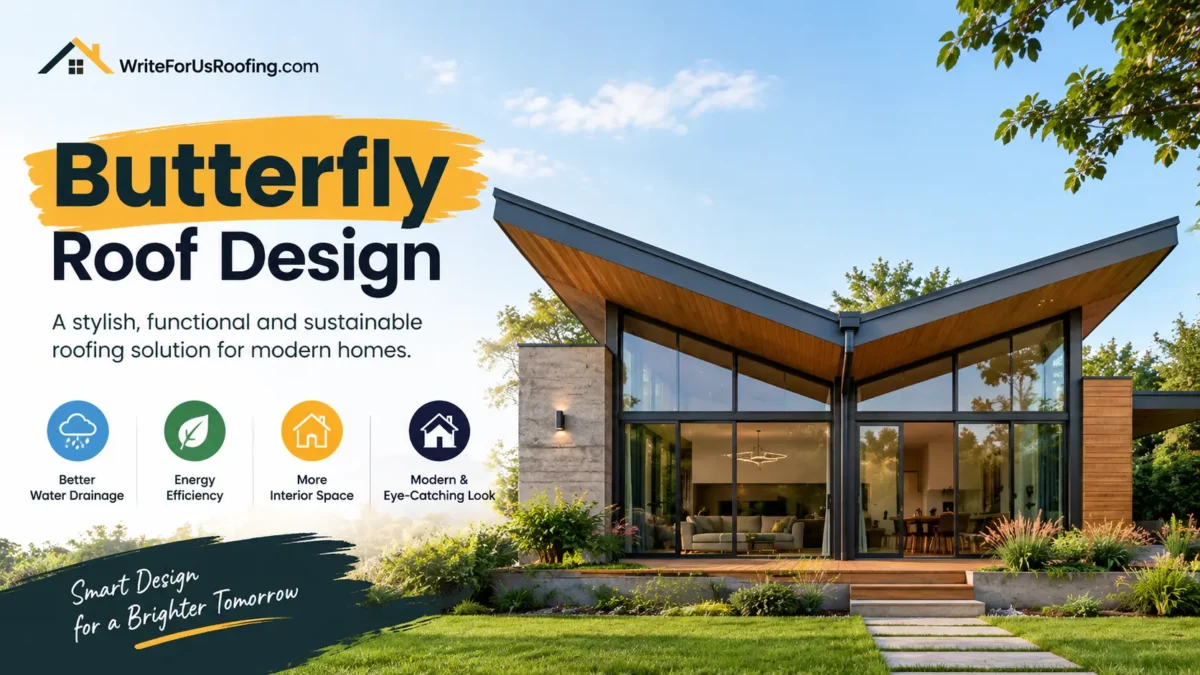
Hello guys, welcome back to my blog. Today I am going to talk about butterfly roof design. You must have seen this roof on some modern house. It is the one that looks like a big “V”, or like a butterfly opening its wings.
Honestly, I really like this roof because it looks very different from normal roofs. But it is not only about looks. It brings lot of natural light inside and it can even collect rainwater for you. On the other hand, it also has some real problems that people don’t talk about much. I have seen what a blocked valley can do to a ceiling, and trust me, it is not pretty.
In this blog I will tell you what a butterfly roof is, where it comes from, and all 15 butterfly roof designs with a simple diagram for each one, plus a quick comparison with gable, shed, flat and hip roofs. I also went through Reddit to see what real engineers and home owners say about it. So let’s get started.
What Is a Butterfly Roof?
A butterfly roof is a roof where two roof surfaces slope down from the outside walls and meet in a valley in the middle. So in simple words, it is a normal gable roof turned upside down. When you see it from the side, it look like the wings of a butterfly going up. That is where the name comes from.
The butterfly roof, also called a V roof, is mostly linked with mid-century modern houses. Some people also call it an inverted gable roof or a valley roof. In UK cities you will find the same idea on old terraced houses, where people call it a “London roof”.
These are the main parts you should know before we go to the designs:
- Wings: The two sloping roof planes. They can be equal or not equal.
- High eaves: The raised outer edges. This is where you get tall walls and big windows.
- Valley: The low line in the center where all the water comes.
- Roof cricket: A small raised hump in the valley that pushes water toward the ends.
- Scupper: The opening at the end of the valley that throws water out into a downspout or rain chain.
- Clerestory windows: The band of high windows under the raised wings.
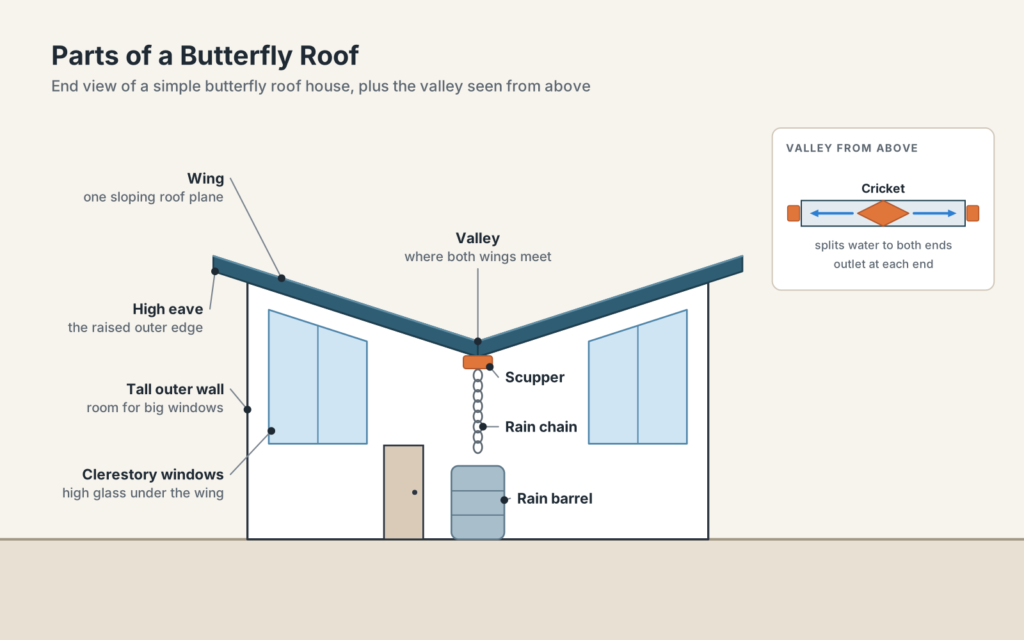
If you ask me, the valley is the heart of this roof. If the valley is designed good, the whole roof works good. If not, you will have problems sooner or later.
| Quick fact | Butterfly roof |
|---|---|
| Other names | V roof, inverted gable, London roof |
| Shape | Two wings sloping down to a center valley |
| Where water goes | Into the valley, then out at one or both ends |
| Famous era | Mid-century modern (1950s) |
| Best for | Warm, dry or mild climates |
| Main risk | Leaks and clogging in the valley |
A Short History of Butterfly Roof Design
The idea of a roof sloping inward is very old. In ancient Roman houses, the roof around the main hall sloped toward a hole in the middle, and the rain fell into a pool called the impluvium. I think this is the real grandfather of the butterfly roof, because the main job was same: bring the water to the center.
The modern butterfly roof started in 1930. Le Corbusier drew it for a vacation house in Chile called Maison Errazuriz, but that house was never built. In 1933, Antonin Raymond used the same idea for his own Summer House in Karuizawa, Japan. Funny thing is, Le Corbusier was shocked when he saw it in a magazine, but later he praised Raymond’s wooden version in a letter.
After that, the roof travelled around the world very fast. Here is the full timeline in a simple table:
| Year | Architect | Building | Why it matters |
|---|---|---|---|
| 1930 | Le Corbusier | Maison Errazuriz, Chile | First butterfly roof design, never built |
| 1933 | Antonin Raymond | Summer House, Karuizawa, Japan | First built butterfly roof house |
| 1943 | Oscar Niemeyer | Yacht Club, Pampulha, Brazil | Part of the Pampulha Modern Ensemble on the UNESCO World Heritage list |
| 1945 | Marcel Breuer | Geller House, Long Island | The roof arrives in the USA |
| 1949 | Marcel Breuer | House in the Museum Garden, MoMA | Thousands of people see it in New York |
| 1950 | Joseph Eichler | Atherwood tract in Redwood City | First California housing tract with butterfly roofs |
| 1956–57 | William Krisel | Twin Palms, Palm Springs | The roof becomes a mid-century icon |
Breuer’s Geller House was a big deal. You can still see the drawings in the Geller House record of the Marcel Breuer Digital Archive. Sadly, the Geller House was demolished in 2022 to make space for a tennis court. Honestly, I feel bad when I read stories like this.
The name most people connect with this roof is William Krisel. With the Alexander Construction Company, he designed nearly 2,000 houses around Palm Springs. But Krisel himself said he did not invent the butterfly roof. He only used it on a scale nobody had done before.
As per the Return of the Butterflies story by Eichler Network, Krisel liked this roof because it sent the water to two small spouts and it was easy to frame. He also warned that if you don’t understand water, the house can turn out bad. I think that warning is still true today.
If you are near Palm Springs, you can still see these homes on the Twin Palms Estates walking tour during Modernism Week. For me this is the best way to understand the butterfly roof, by seeing it with your own eyes.
15 Butterfly Roof Designs (With Diagrams)
Now the fun part, guys. A butterfly roof is not only one shape. Architects play with the angle of the wings, the valley, the windows and the size, and every change gives you a different look and also a different job for the roofer. Below I have listed all 15 designs I know, and I made a simple diagram for each one so you can see how it works.
One tip before we start. In every diagram, first look at where the water goes. That one thing decides if your roof stays dry for 30 years or starts leaking in the second winter.
1. Classic Symmetrical Butterfly Roof
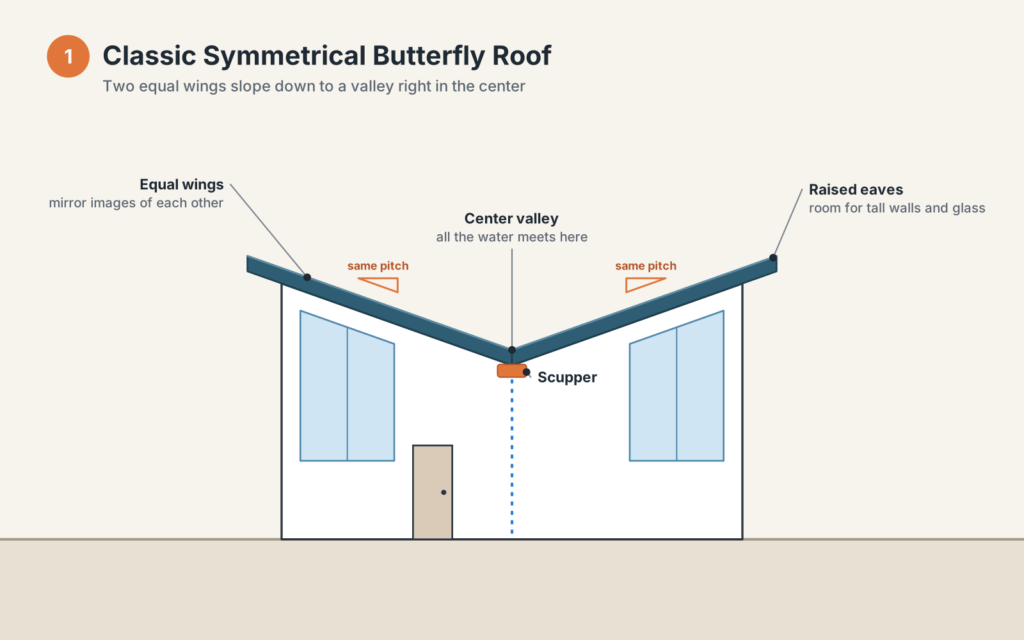
This is the original one which everybody pictures. Two equal wings slope down to a valley right in the middle, so from the front the house looks like a perfect V. Both outer walls go up high, so you get room for tall windows on both sides.
One famous butterfly house from the 1950s is the McCraith House in Dromana, Australia, which people simply call the “Butterfly House”. The architects Chancellor and Patrick built it between 1954 and 1956, and today it is listed on the Victorian Heritage Register.
- Best for: Simple box-shaped houses and people who want the pure mid-century look.
- Watch out for: All the water from both wings lands on one center line, so the valley and the outlet must be big and well made.
2. Asymmetrical (Off-Center) Butterfly Roof
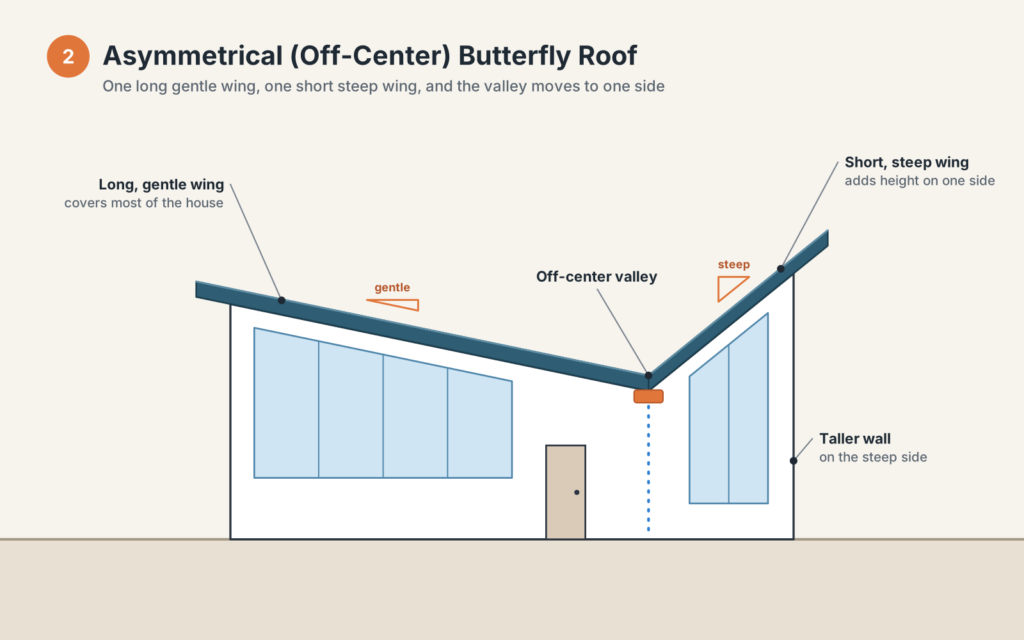
Here one wing is long and gentle, and the other one is short and steep. So the valley does not sit in the middle, it sits off to one side. I really like this design because it looks more modern and less “textbook”.
Dwell featured a Silicon Valley butterfly house by William Duff Architects with “an asymmetrical, Le Corbusier-style butterfly roof”. The short steep wing gives you one very tall wall, which is perfect for a double-height living room or a big glass wall facing the view.
- Best for: Lots with a view on one side, two-story homes, and solar (more on that in design 13).
- Watch out for: The long wing collects most of the water, so size the outlet for that side.
3. Flat-Valley Butterfly Roof With Cricket
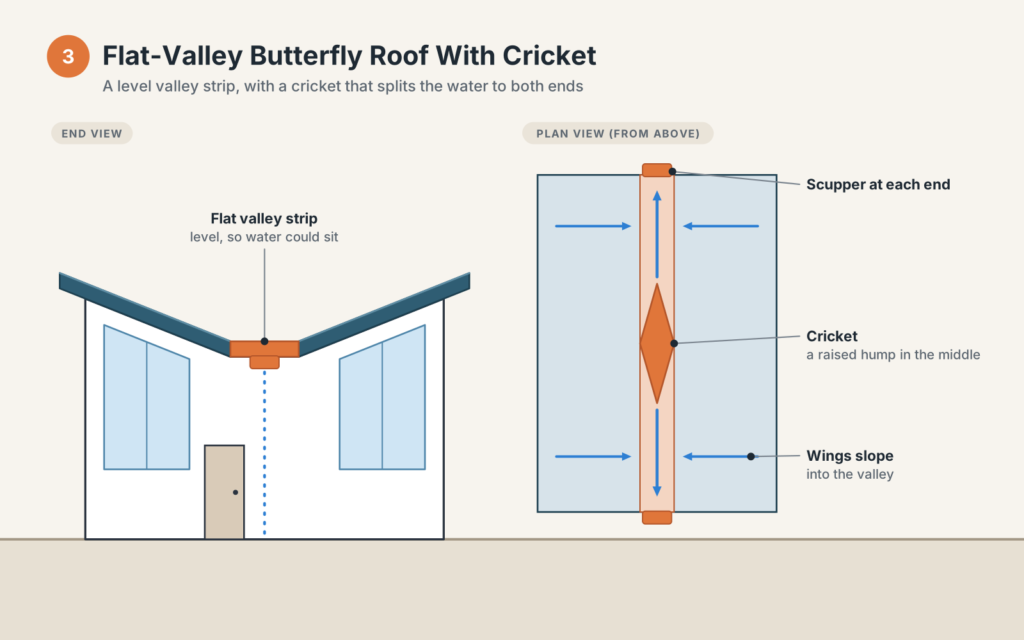
In this design the two wings don’t meet at a sharp line. They meet at a flat strip in the middle, like a small walkway. Flat means water can sit there, so a good roofer adds a cricket. A cricket is a small raised hump in the middle of the valley that pushes water out to a scupper at each end.
This is not just theory, guys. In a JLC article about a leaking butterfly roof in Boulder County, a roofing specialist chased a leak that came only in spring, after 9 to 12 inches of snow. The planned cricket was never built, so melt water ponded, froze on top, and got pushed through a tiny hole over an old screw. His lesson was simple: if the cricket was installed from day one, the leak most likely never would have happened.
- Best for: Wide houses where you want a valley you can walk on for cleaning.
- Watch out for: Never skip the cricket to save money. It costs very little compared to a wet ceiling.
4. Tilted (Sloping-Valley) Butterfly Roof
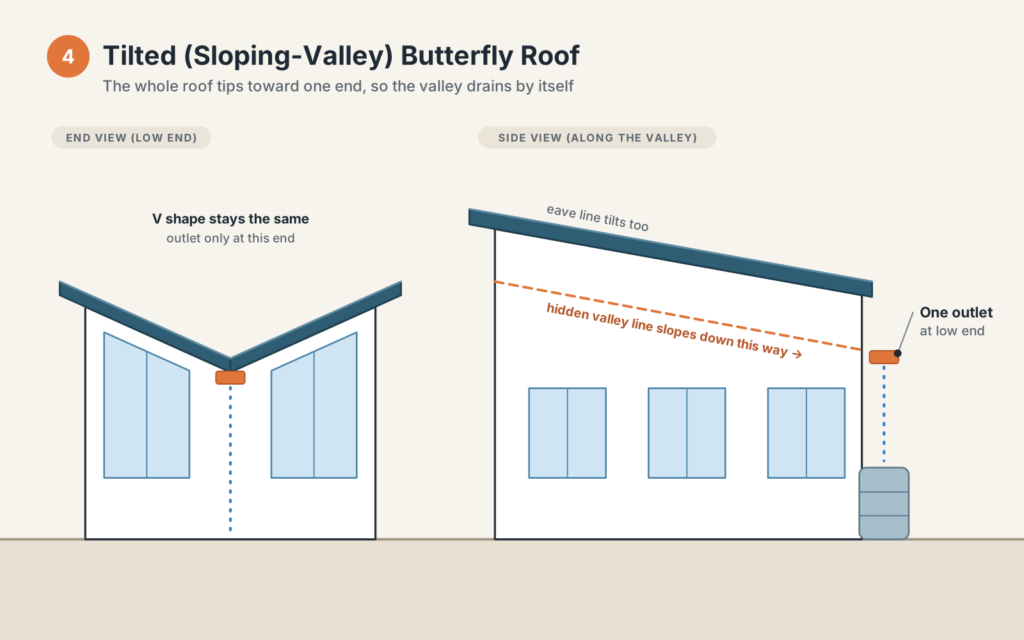
This one is smart. The wings slope into the valley like normal, but the valley itself also slopes from one end of the house to the other. So water never stops in the middle, it keeps running along the valley to one outlet at the low end.
Why this matters? In an InterNACHI forum thread about an unusual butterfly roof, home inspectors looked at a nearly flat valley with one small drain. One inspector said it looked like there had been “a lot of standing water in the valley”. Others said the drain needs a cover (they call it a bonnet) and an emergency overflow scupper, because one day it will clog. A sloped valley fixes most of this from the start.
- Best for: Long houses and rainy places.
- Watch out for: The low end gets all the water, so put a big outlet plus an overflow there, and send the water away from doors and the foundation.
5. Floating Butterfly Roof With Clerestory Windows
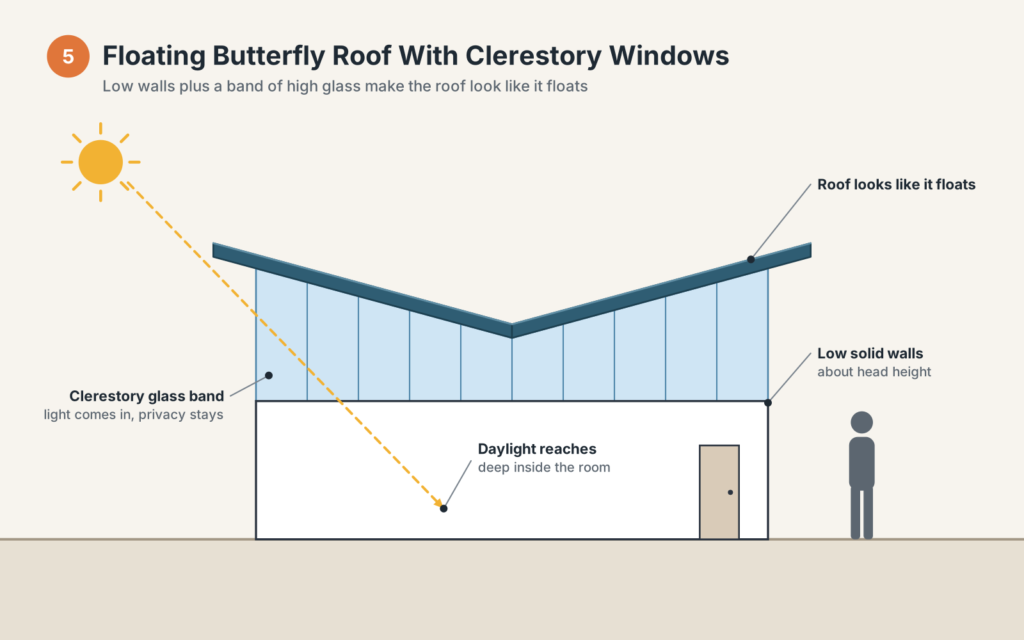
This is my personal favorite. The solid walls stop at about head height, and above them a band of glass runs right under the roof. From outside, the roof looks like it is floating over the house. From inside, daylight comes deep into the room, but the neighbours can’t look in.
The name is not new. In William Krisel’s Twin Palms neighborhood of 90 homes in Palm Springs, one roof style was called the “floating butterfly”. An MIT archive record of a Twin Palms house says this “Floating Butterfly” roofline was not used in the builder’s other neighborhoods and only 12 were built. The more common one there was the “Extended Butterfly”, which stretches over the carport (that’s design 14).
- Best for: Homes close to neighbours, and anyone who wants light without losing privacy.
- Watch out for: The glass band sits right under the roof edge, so flashing and sealing there must be perfect. Use low-E glass, or the room can get hot.
6. Split-Level (Stepped) Butterfly Roof
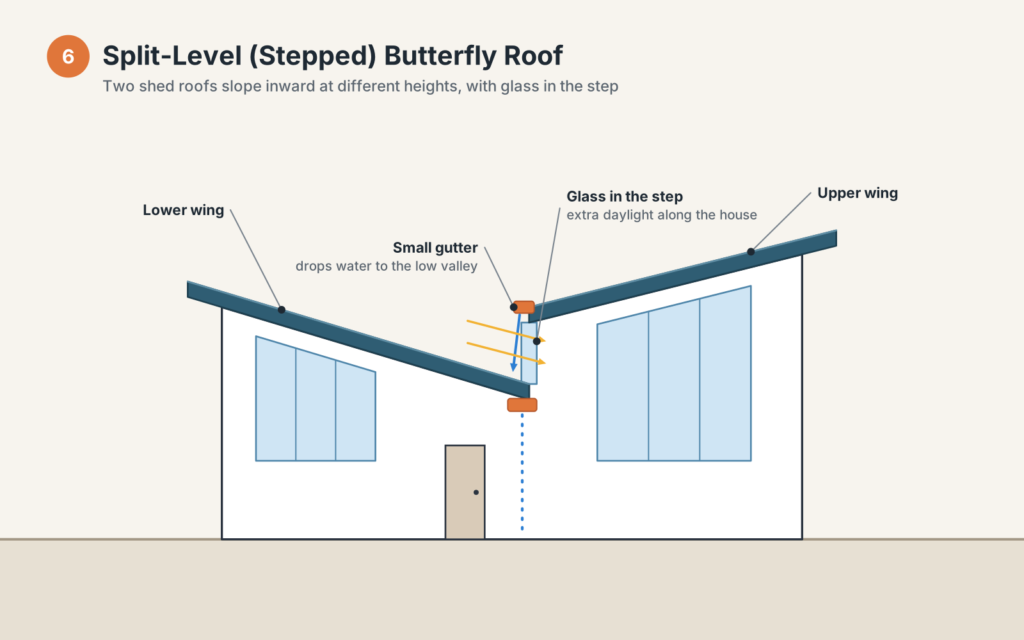
In this design the two wings sit at different heights. One wing is lower, the other is higher, and the step between them is filled with glass. So technically it is two shed roofs leaning toward each other.
Houzz shows a roof like this and explains that it “looks like a butterfly roof” but is actually two skillion roofs which both slant inward, with “a nice clerestory window” in the space between them. In my diagram the upper wing has a small gutter that drops water down to the lower valley.
- Best for: Sloped lots and split-level homes.
- Watch out for: The upper wing must not dump all its water on one spot of the lower roof. Use a gutter and a splash pad.
7. Butterfly Roof With Deep Overhangs
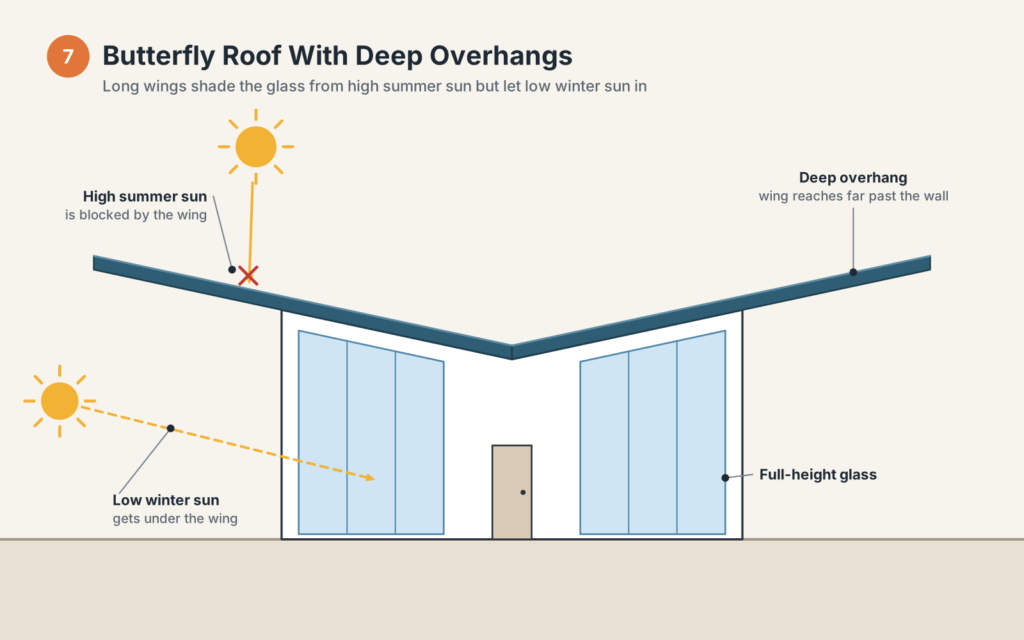
Here the wings reach far past the walls, like a big sun hat. Because the outer edges are high, the overhang blocks the high summer sun but still lets the low winter sun come in under it. In hot places this helps a lot with cooling.
The Building America Solution Center has a nice example of a south window overhang that gives “full shade in the summer and full sun in the winter”. But big overhangs also catch wind. The OAS Caribbean hurricane design slides warn to “avoid large overhangs as high wind force build up under them”, and say overhangs should not be more than 18 inches at the eaves.
- Best for: Hot, sunny places with calm weather, and homes with big glass walls.
- Watch out for: In hurricane or high-wind areas, keep overhangs short or get an engineer to design the tie-downs.
8. Flying (Fly) Butterfly Roof
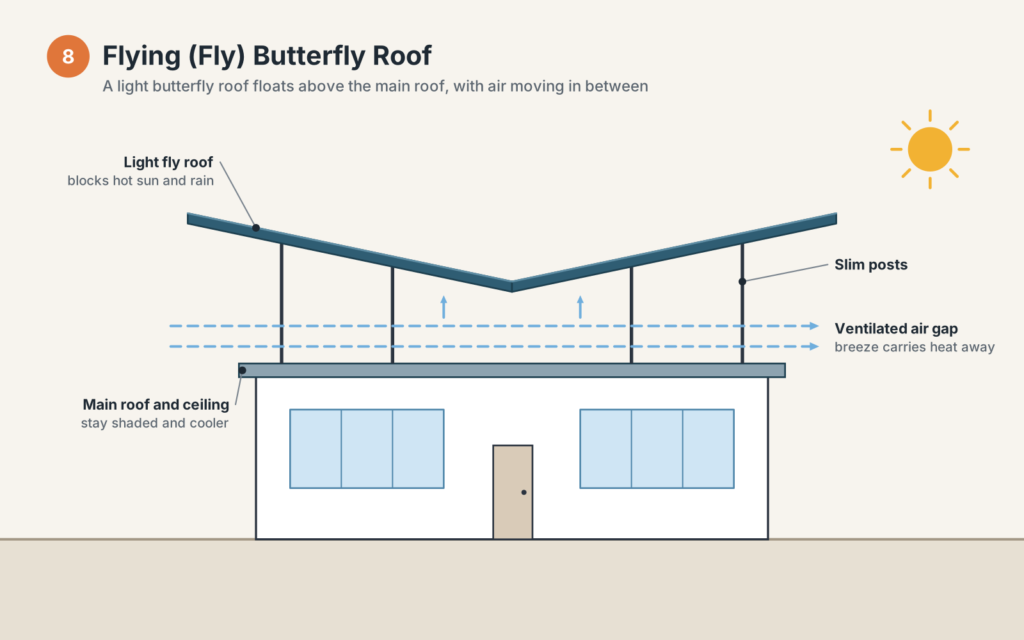
A fly roof is a second, light roof that sits above the main roof on slim posts, with open air in between. In this version the top roof has the butterfly shape. It works like an umbrella for the whole house. Hot sun and rain hit the fly roof first, and the main roof stays in the shade.
You see this a lot in hot climates. The Australian government’s YourHome guide to passive cooling says that in hot humid areas you can “consider shading the whole building with a fly roof”, and that well-ventilated roof spaces “form a buffer” between inside and outside.
- Best for: Very hot and humid climates, outdoor living areas and pavilions.
- Watch out for: It is light and open, so wind can lift it. It needs strong tie-downs, and it costs more because you are building two roofs.
9. Curved Butterfly Roof
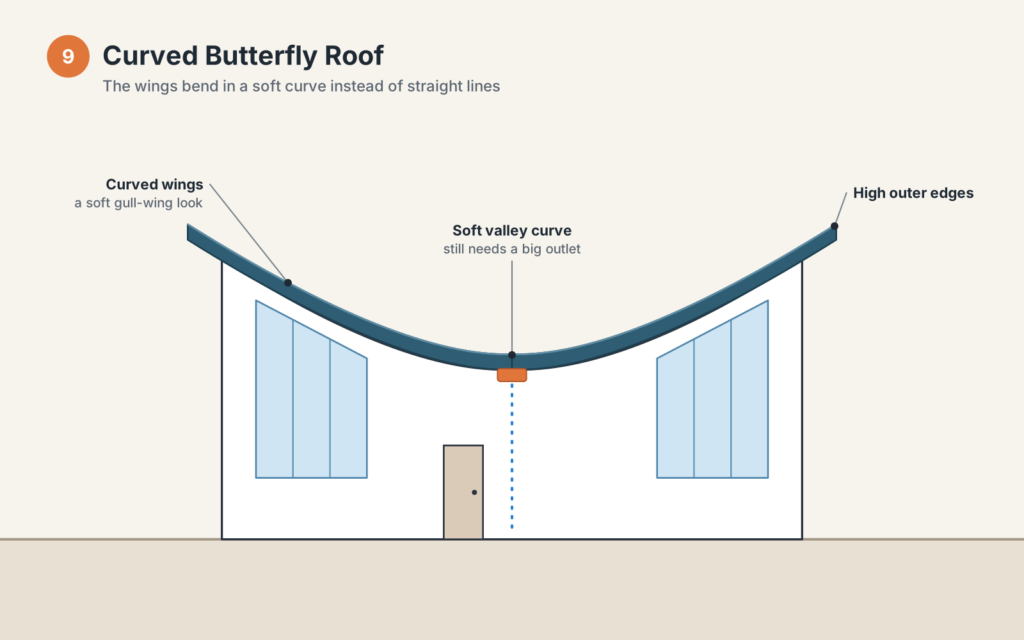
Instead of straight wings, here the wings are curved, like a seagull’s wings. It looks softer and more natural, and honestly it is one of the prettiest roofs you can build.
Even big name architects like this one. The Eichler Network story on why people love butterfly roofs mentions that Pritzker Prize winner Glenn Murcutt “prefers his butterfly wings to curve”. For the roofing, metal sheets are the usual choice because they can bend in a smooth curve.
- Best for: Architect-designed homes, and coastal or garden settings where a soft shape fits.
- Watch out for: Curved framing and curved sheets cost more, and the soft valley still needs a big outlet.
10. Hidden Butterfly Roof (London Roof)
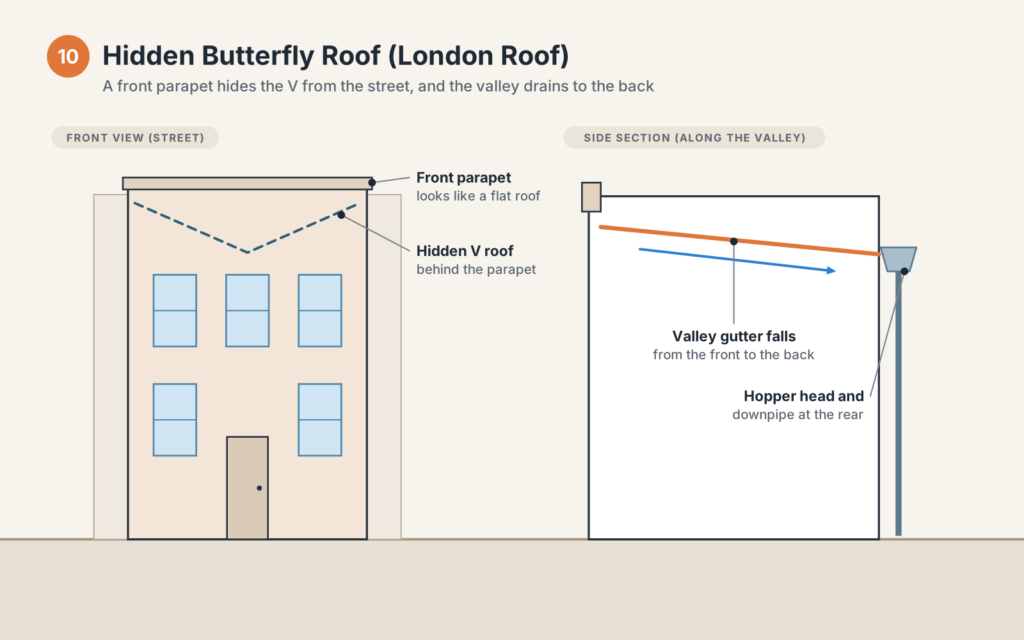
This one is a surprise for many people. Lots of old Georgian and Victorian terraced houses in London have a butterfly roof, but you can’t see it from the street. The front wall goes up as a parapet, so the house looks like it has a flat roof. Behind it there is a V-shaped roof, and the valley gutter runs from front to back, where a hopper head and downpipe take the water down.
You can see this in a Camden Council planning letter about a terraced house, which says “a parapet at roof level conceals a butterfly roof with central valley running from front to rear”. In the same letter, the council calls the street’s run of V-shaped valley roofs “distinctive” and says the ones still intact “should be preserved”.
- Best for: Old terraced houses. Mostly this one is about repairing and keeping what is already there.
- Watch out for: The valley gutter is out of sight, so leaves and blockages build up without anyone noticing. Get it checked at least once a year, and talk to your council before any loft extension.
11. Double or Zigzag Butterfly Roof
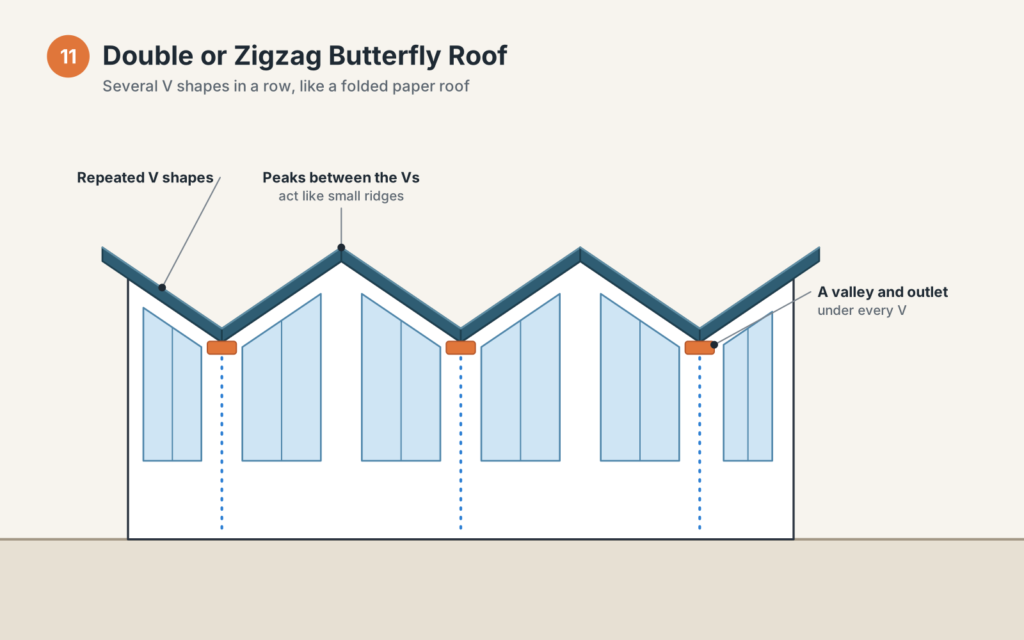
Why stop at one V? In this design the roof has two or more V shapes in a row, like a zigzag. The peaks between the Vs act like small ridges, and every V has its own valley and outlet.
A famous example is the 1959 Zigzag House in Sarasota, Florida, named for a roofline that “resembles saw teeth”. When it was renovated, Dwell described its heritage roof as panels arranged in a V formation, with glass triangles filling the zigzags to bring light inside.
- Best for: Long, wide buildings and anyone who wants a real statement roof.
- Watch out for: Every extra V means one more valley, one more outlet and one more place to clean.
12. Rainwater Harvesting Butterfly Roof
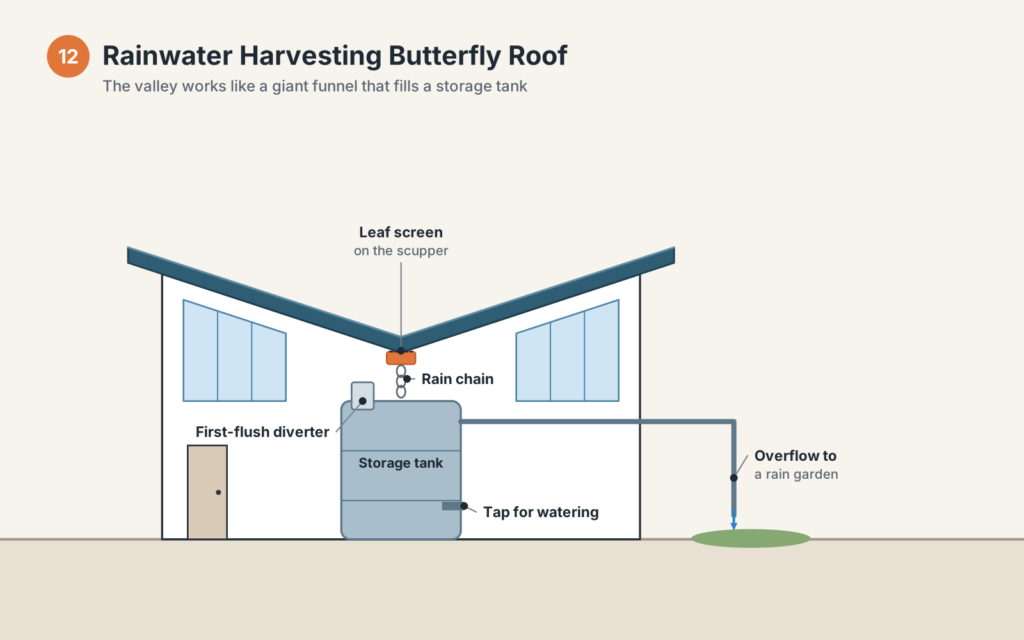
This is where the butterfly roof really shines. All the water already comes to one valley, so it is very easy to catch it. In my diagram the scupper has a leaf screen, a rain chain brings the water down, a first-flush diverter throws away the first dirty water, and the rest goes into a barrel with a tap. Extra water overflows to a rain garden.
Some quick facts:
- The EPA page on rain barrels says they “capture water from a roof and hold it for later use such as on lawns, gardens or indoor plants”.
- The Texas Manual on Rainwater Harvesting says you can collect about 0.62 gallons per square foot of roof for each inch of rain. So a 1,500 square foot roof can give you around 930 gallons from one inch of rain (a bit less in real life, because of splash and overflow).
- The same manual explains that a first-flush diverter sends the first flow of water away from the tank, so dust, pollen and bird droppings don’t end up in your barrel.
- A rain chain, called kusari-doi in Japan, is used instead of a downspout and turns the falling water into a small water feature.
So it is a win-win, guys. The roof shape that people worry about for drainage is actually the best roof for catching water.
- Best for: Dry places, gardens, and anyone who wants to save on water.
- Watch out for: Mosquitoes and dirty water. Keep screens on, don’t drink it without proper treatment, and check if your state or city has rules on collecting rainwater.
13. Solar Butterfly Roof
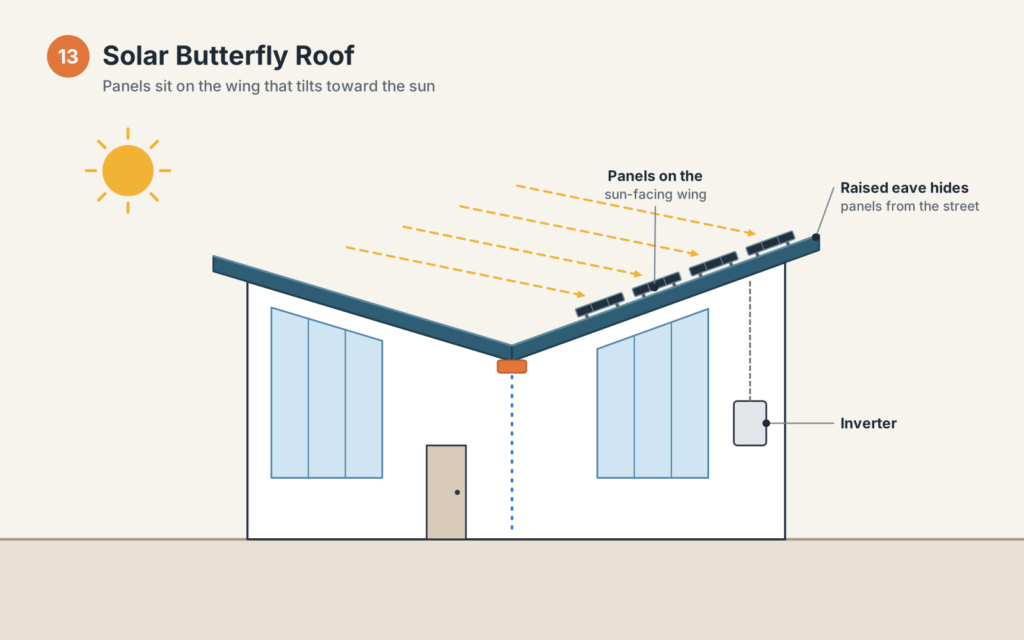
A butterfly roof can carry solar panels, but there is a catch. The two wings face opposite directions, so only one of them faces the sun well. In the US, that’s the wing whose surface faces south, so put the panels there.
A Penn State solar course page gives the basic rule: face the panels due south and tilt them at about the same angle as your latitude. Most butterfly wings are flatter than that, so panels lying flat on the wing make a little less power, or you can use tilt racks. Before you buy anything, put your address into NREL’s free PVWatts solar calculator to see how much power you would really get. One nice bonus: the raised outer eave hides the panels from the street.
- Best for: Sunny places, and homeowners who want panels that don’t spoil the look. If you plan solar from day one, use the asymmetrical design and make the big wing the sun-facing one.
- Watch out for: Every panel bracket is a hole in your roof. Make sure the roofer and the solar installer agree on the flashing, especially near the valley.
14. Extended Butterfly Roof Over a Carport or Porch
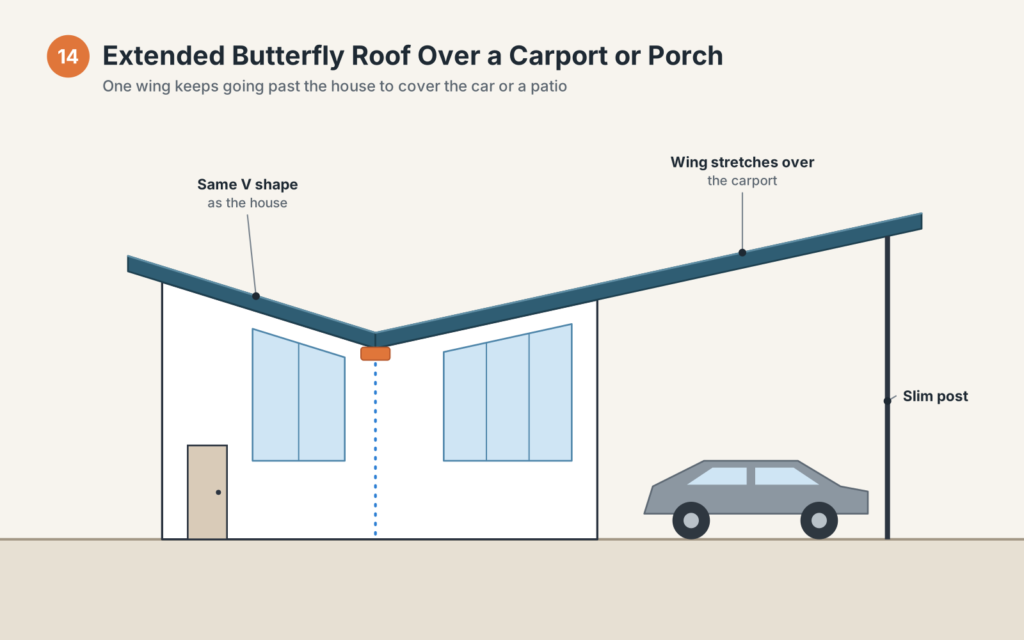
Here the same V shape of the house stretches out to cover the carport, a porch or a patio, held up by slim posts. It makes the house look longer and lower, which is a very classic mid-century look. As I told you in design 5, this “Extended Butterfly” was the more common version in Krisel’s Twin Palms houses.
The V shape also works on its own for open shelters. Milo Ketchum’s page on butterfly shells says this shape “is often used for canopies” and for “railroad station platform covering”. But open roofs catch wind from below. The OAS slides on hurricane-safe house design say that “if overhangs or canopies are desired, they should be separated from the main roof structures”. So in storm areas, ask your engineer if the carport roof should be its own structure.
- Best for: Carports, porches, patios and entry canopies.
- Watch out for: Wind uplift on the open side, and valley water falling right where people walk or park.
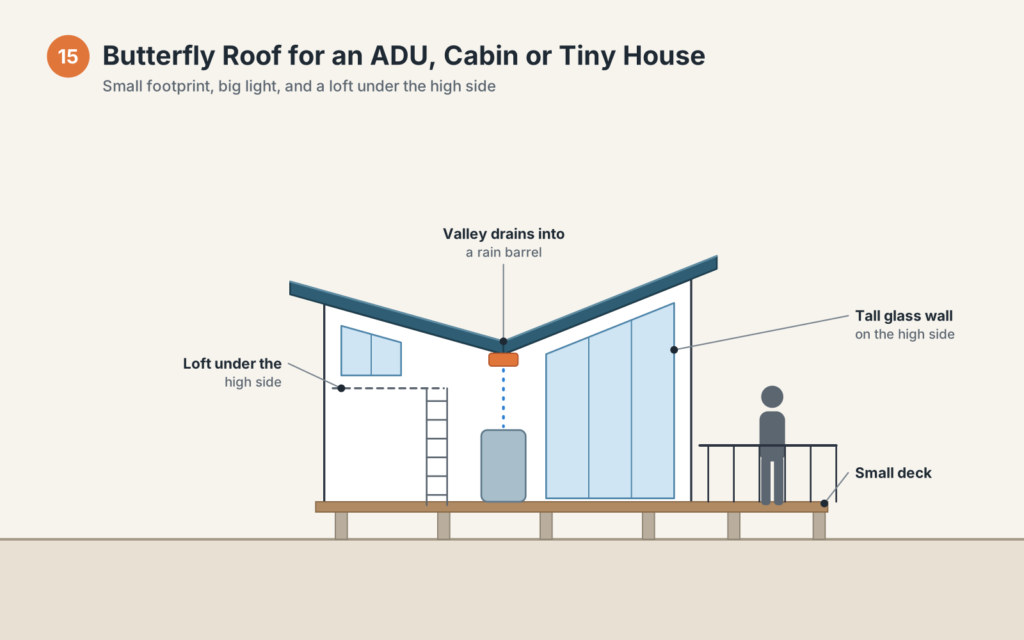
15. Butterfly Roof for an ADU, Cabin or Tiny House
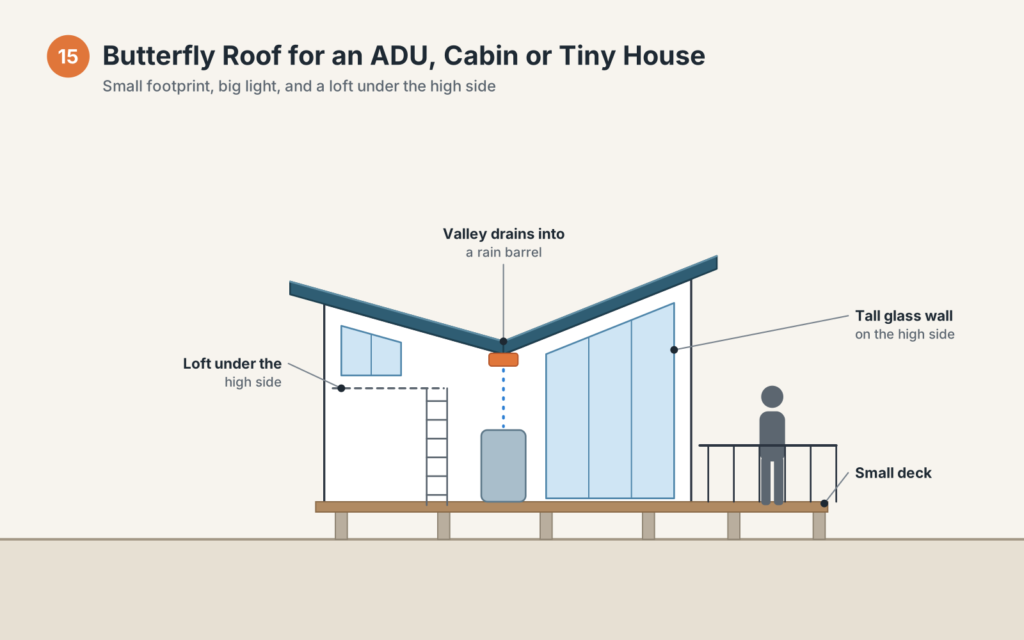
Small buildings look really good with a butterfly roof. On a backyard ADU (a small second home on the same lot), a cabin or a tiny house, the high side gives you space for a loft and a tall glass wall, and the valley can drain straight into a rain barrel. And since the roof is small, the cost stays small too.
A good example is the Butterfly Roof House by thescape in South Korea. ArchDaily lists its area as 85 m² (about 915 square feet), and the client asked for a simple square plan, partly to keep the building cost down. If you are new to ADUs, AARP’s ABCs of ADUs guide explains the basics in plain words.
- Best for: Backyard ADUs, home offices, cabins and tiny homes.
- Watch out for: A small valley fills with leaves very fast, and many cities have height limits for ADUs, so check before you design that tall wall.
All 15 Designs at a Glance
| # | Design | Best for | Watch out for |
|---|---|---|---|
| 1 | Classic symmetrical | Simple box houses, mid-century look | All water meets in one center valley |
| 2 | Asymmetrical (off-center) | View lots, two-story homes, solar | Long wing sends more water |
| 3 | Flat valley with cricket | Wide houses, walkable valley | Never skip the cricket |
| 4 | Tilted (sloping valley) | Long houses, rainy places | Big outlet and overflow at the low end |
| 5 | Floating with clerestory | Daylight with privacy | Flashing at the glass band |
| 6 | Split-level (stepped) | Sloped lots | Upper wing dumping water on the lower roof |
| 7 | Deep overhangs | Hot, sunny places | Wind uplift in storm areas |
| 8 | Flying (fly) roof | Hot, humid climates | Two roofs to pay for and tie down |
| 9 | Curved | Architect-designed homes | Higher framing and sheet cost |
| 10 | Hidden (London roof) | Old terraced houses | Blocked hidden valley gutter |
| 11 | Double or zigzag | Long, wide buildings | More valleys to clean |
| 12 | Rainwater harvesting | Dry places, gardens | Mosquitoes and dirty first flush |
| 13 | Solar | Sunny places | Only one wing faces the sun |
| 14 | Extended over carport or porch | Carports, porches, patios | Wind uplift on the open side |
| 15 | ADU, cabin or tiny house | Backyard units, small homes | Leaves fill a small valley fast |
If you ask me which one I would pick for a normal family home, I would go with the tilted valley (design 4) or the asymmetrical one (design 2). On both of them the water keeps moving, and moving water is happy water. Any roofer will tell you that water sitting still on a roof is where all the trouble starts.
Butterfly Roof vs Other Roof Designs
To really understand the butterfly roof, it helps to put it next to the roofs you see every day. The biggest difference comes down to one simple question: where does the water go? I made the same kind of diagram for the four most common roofs, so you can compare them easily.
Gable Roof
The gable roof is the classic triangle roof that every kid draws. Two slopes meet at a ridge on top, and water runs off to both outer edges into the gutters. It is the exact opposite of a butterfly roof. A gable sheds rain and snow easily and gives you a big attic, but you lose the tall outer walls and the high windows.
Shed (Skillion) Roof
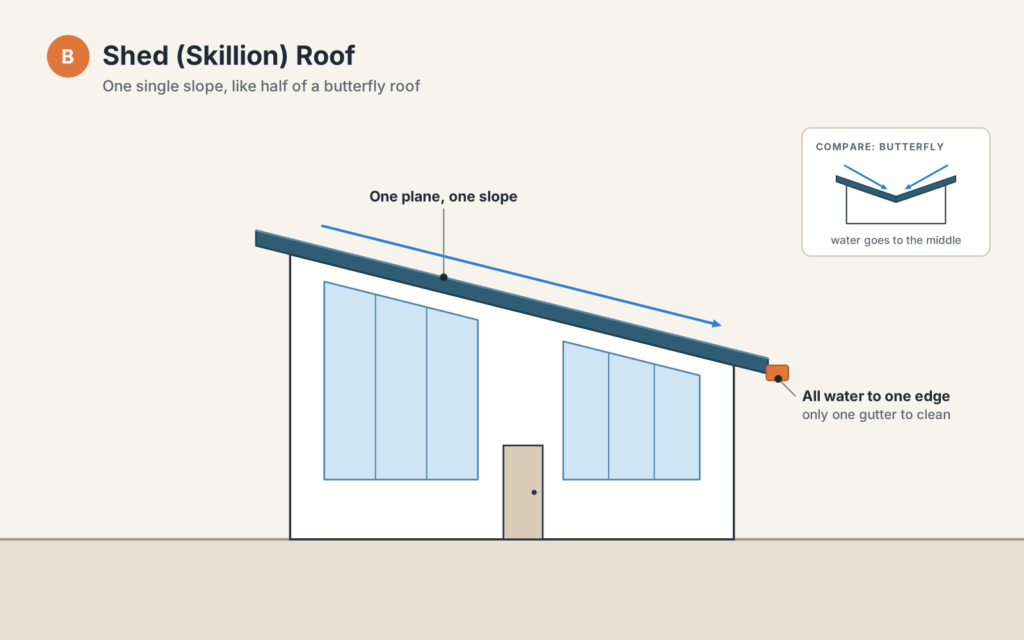
A shed roof, also called a skillion roof, is just one single slope. A butterfly roof is basically two shed roofs leaning into each other. With a shed roof all the water goes to one edge, so there is only one gutter to clean and no valley at all. If you love the modern look but the valley scares you, this is your safest choice.
Flat (Low-Slope) Roof
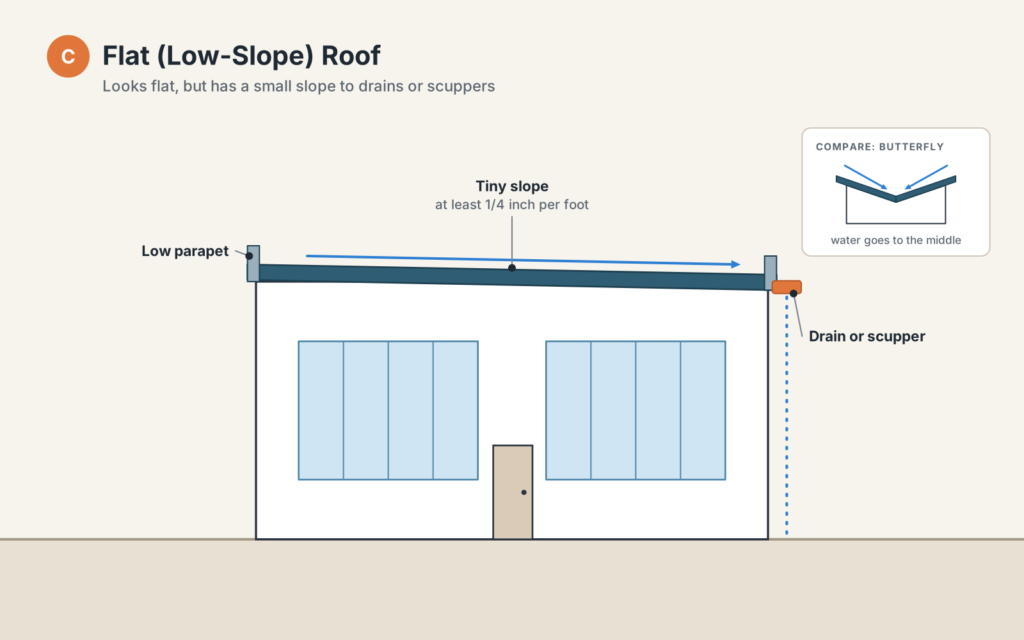
A flat roof looks flat, but a good one always has a small slope, at least 1/4 inch per foot, toward drains or scuppers. It has the same weak point as a butterfly valley: if water can sit, it will sit. That is why both of them need a membrane like TPO or EPDM, not normal shingles.
Hip Roof
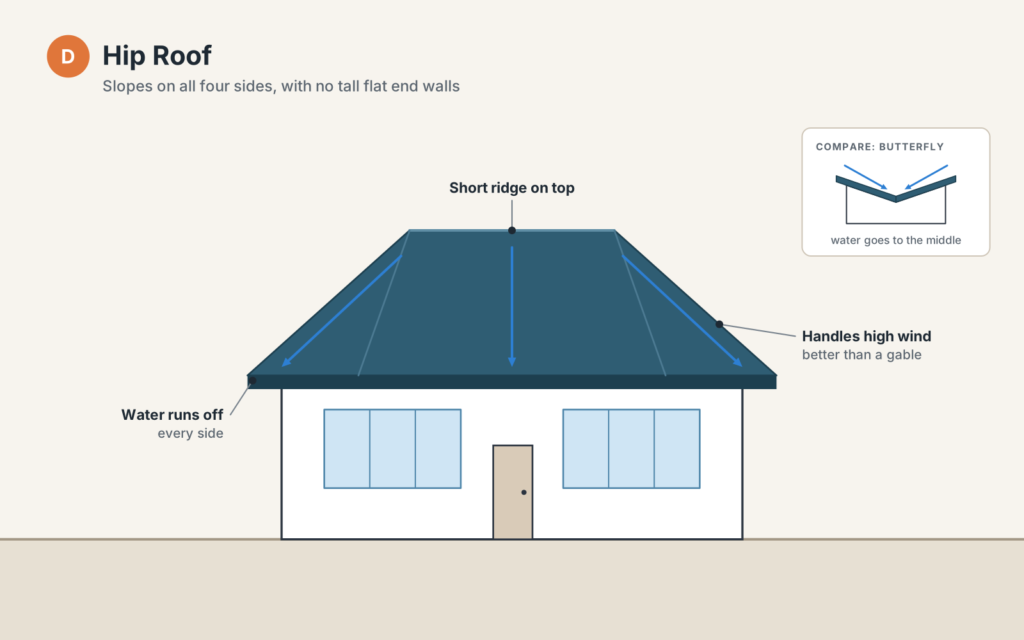
A hip roof slopes down on all four sides, with a short ridge on top, and water runs off every side. In strong wind it is the toughest of the bunch. The Building America Solution Center’s hip vs gable guide says peak wind pressures “can be as much as 50% lower in a hip roof versus a gable roof”. But it is more complex to build, it costs more, and it has none of the open, airy feeling of a butterfly roof.
Quick Comparison Table
| Roof type | Where water goes | Typical cost | Snow and heavy rain | Attic space |
|---|---|---|---|---|
| Butterfly | Center valley | $7,000–$18,000 | Weak, needs great drainage | None |
| Gable | Both outer edges | $7,000–$20,000 | Good | Lots |
| Shed (skillion) | One outer edge | $6,000–$12,000 | Good if steep enough | Very little |
| Flat (low-slope) | Drains or scuppers | $8,000–$26,000 | Weak, ponding risk | None |
| Hip | All four sides | $24,000–$36,000 | Good | Some |
The costs are national ranges from the Angi roof types guide that I linked further down in this post, so your local price can be quite different.
My honest opinion: if you live where it snows a lot, a gable or hip roof is simply the safer choice. But if you live somewhere mild and you love light and modern style, the butterfly roof gives you something no other roof can.
Pros of Butterfly Roof Design
Now let’s talk about the good side. If you ask me, these are the main reasons people fall in love with this roof:
- Lots of natural light: The high outer walls give space for tall windows and clerestory glass. The eXtension guide on passive solar daylighting lists clerestories as one of the main ways to bring daylight inside, so you need less lights in the day.
- High ceilings and open feeling: Inside, you get a tall ceiling near the walls and a lower one in the middle. It makes rooms feel big and airy.
- Easy rainwater collection: All the water goes to one valley, so it is very easy to catch it in a tank or barrel.
- Good for solar panels: The wings can face the sun and also hide the panels from the street. The UC Irvine teamMADE study of their butterfly roof ADU found their roof shape gets more even sun across the day than a normal gable roof.
- Unique modern look: Atomic Ranch calls the butterfly roofline one of the most eye-catching rooflines of the mid-century era. Your house will stand out on the street for sure.
- Privacy with views: With high windows you can see the sky, trees and mountains, but neighbours can’t look inside.
- Simple framing on long houses: Krisel said it is just two shed roofs meeting, with no complicated hips or ridges.
Honestly, for me the light is the biggest plus point. A room full of soft daylight feels totally different from a room with small windows.
Cons of Butterfly Roof Design
Now the bad side. Guys, please read this part carefully before you fall in love with the look.
- Valley drainage problems: All the water, leaves and snow come to one place. If the outlet gets blocked, the water stays there and finds a way inside.
- Costly repairs: Angi’s roof repair cost guide puts butterfly roofs at the top of its repair list, at about $1,200 to $6,000 or more per repair. That is more then a simple gable roof.
- Snow and ice: Snow drifts into the valley and adds heavy load. When it melts and freezes again, it can push water under the roofing.
- Trees mean more cleaning: Leaves and small branches slide down both wings and pile up in the center.
- Higher building cost: The framing, waterproofing and drainage all need extra work and good materials.
- Odd room shapes and no attic: Property Investments UK points out that this roof can give awkward room shapes and you can’t use the roof space like a loft. They also say damage is harder to spot, because much of the roof is hidden from below.
- You need experienced people: A normal roofer who only does shingle roofs may not know how to detail the valley.
I am not saying don’t build it. I am only saying go in with open eyes and a good budget for maintenance.
What Real People on Reddit and Forums Say
I always like to check what real people say, not only the brochures. So I went through the discussions of structural engineers on Reddit’s r/StructuralEngineering and a few other forums. Here is the short version.
The good things people mention on Reddit:
- The raised outer edges let you have tall windows and get lots of light in. But your room layout must work with the changing ceiling height.
- Many people simply love the look. One person in Michigan said every butterfly roof owner he talked to had a water collection system right under the V.
The problems people mention on Reddit:
- Everything gets channelled to the valley. People listed water, leaves, branches, pine cones, even dead birds and soccer balls.
- One engineer from north Queensland, Australia said these roofs are a bad idea there. The center needs a box gutter, and with their heavy rain they are prone to leaking.
- Another person said on a wooded site, the owner has to climb up every fall just to clear leaves.
- On structure, one engineer said it is no better or worse than a gable roof, but in snow areas it is much worse.
- Still, the most balanced comment was this one: “It can look amazing and perform well if designed and detailed properly.”
What other forums add:
| Forum | Who is talking | What they said |
|---|---|---|
| Archinect forum thread on butterfly roofs | Architects | One architect detailed a school with two butterfly roofs over 10 years before, with no issues, by using tapered insulation to an internal drain |
| Somersoft forum on why there are not more butterfly roofs | Australian builders and owners | A Perth builder said his clients clear their gutters every two weeks, and hail can block the downpipes |
| InterNACHI home inspector discussion | Home inspectors | One inspector in a desert climate saw no problems, others were worried about snow and debris |
| Green Building Advisor Q&A on an addition roof | Building science experts | An expert from ice dam country said the words “butterfly roof” give him butterflies |
| DIYnot thread on a leaking inverted pitch roof | UK homeowner | Water kept standing in the central gully after rain because there was not enough fall |
So what I learned is simple. The roof is not bad, but it does not forgive mistakes. A good design in a dry place can last for decades, and a lazy design in a rainy or snowy place will give you headache every year.
How to Design Butterfly Roof Drainage the Right Way
If you remember only one section from my blog, make it this one. A butterfly roof lives or dies by its drainage. Water always finds the weakest spot on a roof, and on this roof that spot is the valley. Here are the rules I always look for:
- Give the roof real slope. Membrane roofs need at least 1/4 inch of fall per foot (about 2%). The Florida Roofing association article on ponding water explains that this is the minimum in the building code for membrane roofs.
- Don’t let water sit. The roofing industry calls it ponding when water stays on the roof more than 48 hours after rain. Ponding slowly kills the membrane and adds weight.
- Build a cricket in a flat valley. If the valley itself is level, a cricket pushes water to the ends. A Construction Specifier article on low-slope drainage says a cricket’s slope should be at least double the roof slope, or it simply won’t work.
- Always have a backup outlet. The IIBEC technical advisory on secondary drainage explains the code rule for emergency overflow drains or scuppers when water can get trapped. Put the overflow a little higher than the main outlet, so it only works when the main one is blocked.
- Use two outlets, not one. A home inspector thread about a debris-filled valley shows what happens when a long, flat valley has nowhere to go.
- Size the gutter for storms, not for normal days. In places like Australia and the UK, the center is often a box gutter. Make it big and give it more then one outlet.
| Part | What to do | Why it matters |
|---|---|---|
| Wings | At least 1/4 inch per foot | Water must keep moving |
| Valley | Slope it, or add a cricket | Stops ponding in the middle |
| Main outlets | Two scuppers or drains | One can block, two rarely do |
| Overflow | Set a bit above main outlet | Safety when outlets clog |
| Leaf guard | Screen over each outlet | Leaves are the number one enemy |
I think people spend too much time on the shape and too little time on these boring details. But these boring details are exactly what keeps your ceiling dry.
Best Roofing Materials for a Butterfly Roof
Most butterfly roofs are low slope, so normal shingles are usually not the right choice. You need a roof covering that is fully waterproof, not just water-shedding. The SPRI guide to single-ply roofing explains the two main families: thermoset rubber like EPDM, and thermoplastics like TPO and PVC.
| Material | Lowest slope allowed | Good for butterfly roof? | My take |
|---|---|---|---|
| EPDM rubber | 1/4 inch per foot | Yes, very common | Flexible and good in cold areas |
| TPO membrane | 1/4 inch per foot | Yes | Heat-welded seams, white color reflects sun |
| PVC membrane | 1/4 inch per foot | Yes | Strong welded seams, a bit costly |
| Modified bitumen | 1/4 inch per foot | Yes | Old and trusted, often used in valleys |
| Standing seam metal | 1/4 inch per foot | Yes, on the wings | Long panels with no seams across the water path |
| Asphalt shingles | 2 inch per foot | Only on steeper wings, never in the valley | Not my choice here |
For shingles, the code rule on minimum pitch for asphalt shingles says you need at least a 2 in 12 slope, with double underlayment up to 4 in 12. For metal, the MBCI guide to metal panels and roof slope explains that standing seam can go down to 1/4 in 12, but lapped panels need much more slope.
If you ask me, a membrane valley with standing seam metal wings is a really nice combo. You get the clean modern look on top, and a fully waterproof valley where the water actually collects.
How Much Does a Butterfly Roof Cost?
As per the Angi guide to 14 common roof types, a butterfly roof costs around $7,000 to $18,000 in the US. For comparison, the Angi roof replacement cost guide says an average roof replacement costs $9,609, or about $4 to $11 per square foot. Angi also puts a normal roof inspection at around $240.
| Item | Typical cost (USD) | Source |
|---|---|---|
| New butterfly roof | $7,000–$18,000 | Angi roof types data |
| Average roof replacement (any type) | $9,609, range $5,902–$46,000 | Angi |
| Roof replacement per sq ft | $4–$11 | Angi |
| Butterfly roof repair | $1,200–$6,000+ | Angi repair guide |
| Roof inspection | About $240 | Angi |
| Rain barrel for the valley outlet | $80–$275 | Delaware DNREC |
The rain barrel price comes from a Delaware DNREC fact sheet on rain barrels. Honestly, the roof covering is not the only cost. You should also budget for these things:
- Bigger beams to carry the roof without a center ridge
- Valley membrane, crickets, scuppers and overflow outlets
- Tall windows and clerestory glass under the high wings
- Architect and structural engineer fees
- Regular cleaning and inspections every year
These are average US prices, guys. Labor and material prices change a lot from one state to another, so please take two or three local quotes before you decide.
Is a Butterfly Roof Right for Your Climate?
This is the most important question, if you ask me. The same roof that works perfect in Palm Springs can be a nightmare in a snowy town.
| Climate | Good idea? | What to watch |
|---|---|---|
| Hot and dry (desert) | Yes, the best match | Sun damage on the membrane, so use a light color |
| Mild coastal | Yes | Normal cleaning and checks |
| Heavy rain and big storms | Only with big gutters | Large valley gutter, many outlets, overflow |
| Snow and freeze-thaw | Risky | Snow drifts, extra weight, ice in the valley |
| Wooded site | Possible | Leaves and branches, cleaning every fall |
Snow areas: The FEMA Snow Load Safety Guide warns that drifting and sliding snow create unbalanced loads that can overload a roof. A V-shaped roof is basically a snow trap. Even engineers on an Eng-Tips thread about snow loads on a butterfly truss were debating how to treat the valley under the snow code.
Ice: Ice dams form when heat from the house melts the snow, and the water freezes again at a colder spot. The University of Minnesota Extension guide on preventing ice dams says the long-term fix is to make the ceiling airtight first, and then add insulation. It also warns that complex roof designs increase the risk. Their page on protecting your home from rain and ice reminds that every roof layer and flashing must send water out and over the layer below it.
Heavy rain: If you live in a place with heavy rain storms, like Florida or the Gulf Coast, think twice. The valley must handle a full storm in a few minutes, so the gutter and outlets need to be big, and you need a backup overflow.
Hot and dry: This is where the butterfly roof really shines. Rain is rare, so every drop you collect is useful, and the high windows can bring in light while deep overhangs keep the hard sun out.
My Tips Before You Build a Butterfly Roof
If you are serious about this roof, these are my tips. I collected them from the sources above and from what I have seen on real roofs.
- Hire people who have done it before. Ask your architect and roofer to show you a butterfly roof they built at least five years ago.
- Keep the wings long. Krisel himself said short butterflies don’t look good. The shape needs length to look elegant.
- Get the structure right. Without a center ridge, the beams carry more work. Long spans often use glulam (glued laminated) beams. The Think Wood guide to glulam explains how its layers are joined end to end to allow long spans, and the APA guide to glulam has the technical side.
- Design the valley first, not last. Decide the slope, the cricket, the two outlets and the overflow before you finalize the look.
- Plan your ceilings. Put tall rooms like the living area under the high side, and bathrooms or storage near the low valley.
- Think about the sun. Point the high windows to the light you want, and use overhangs to block summer sun.
- Inspect twice a year. NRCA recommends roof inspections at least twice a year, in spring and fall. For a butterfly roof I think this is a must, not an option.
- Add leaf guards on every outlet. It is a small cost that saves you from big leaks.
- Check your local code. Your local building department will have rules for snow load, drainage and roof slope.
Trust me, a few extra days of planning now will save you lot of money later.
FAQs About Butterfly Roof Design
1. What is a butterfly roof design?
A butterfly roof design is a roof with two wings that slope down toward a valley in the middle, like a V. It is the opposite of a gable roof, and it is famous on mid-century modern homes.
2. Do butterfly roofs leak?
A well designed butterfly roof does not have to leak. Most leaks come from a flat valley, blocked outlets, no overflow, or the wrong roofing material. Good slope, a cricket and regular cleaning solve most of the problems.
3. How much does a butterfly roof cost?
In the US, a butterfly roof costs around $7,000 to $18,000 as per Angi. The final price depends on size, materials, structure and drainage details.
4. Is a butterfly roof design good for snowy areas?
Honestly, it is risky. Snow collects in the valley and adds heavy load, and melting snow can freeze into ice. If you still want one, get a structural engineer, a strong valley detail and very good insulation.
5. What is the minimum slope for a butterfly roof?
If you use a membrane like EPDM, TPO or PVC, the building code minimum is 1/4 inch per foot. Many designers go steeper than this for the wings, so water moves faster.
6. Who invented the butterfly roof?
Le Corbusier first designed it in 1930 for a house in Chile, but that house was never built. Antonin Raymond built the first one in Japan in 1933, and William Krisel made it famous in Palm Springs in the 1950s.
Final Words
So guys, these were all 15 butterfly roof designs, from the classic symmetrical V to the solar, rainwater, zigzag and floating styles. I have tried to cover the history, the diagrams, the pros and cons, the cost, and what real people on Reddit and other forums say about it.
If you ask me, the butterfly roof is one of the most beautiful roofs ever designed. But it is a roof for people who are ready to plan the drainage properly and clean it regularly. In a dry or mild climate, I would happily choose it. In a snowy or very rainy place, I would think two times.
I hope this blog helped you to understand butterfly roof design in an easy way. Keep on visiting Write for Us Roofing for more roofing guides like this.
Also Read: