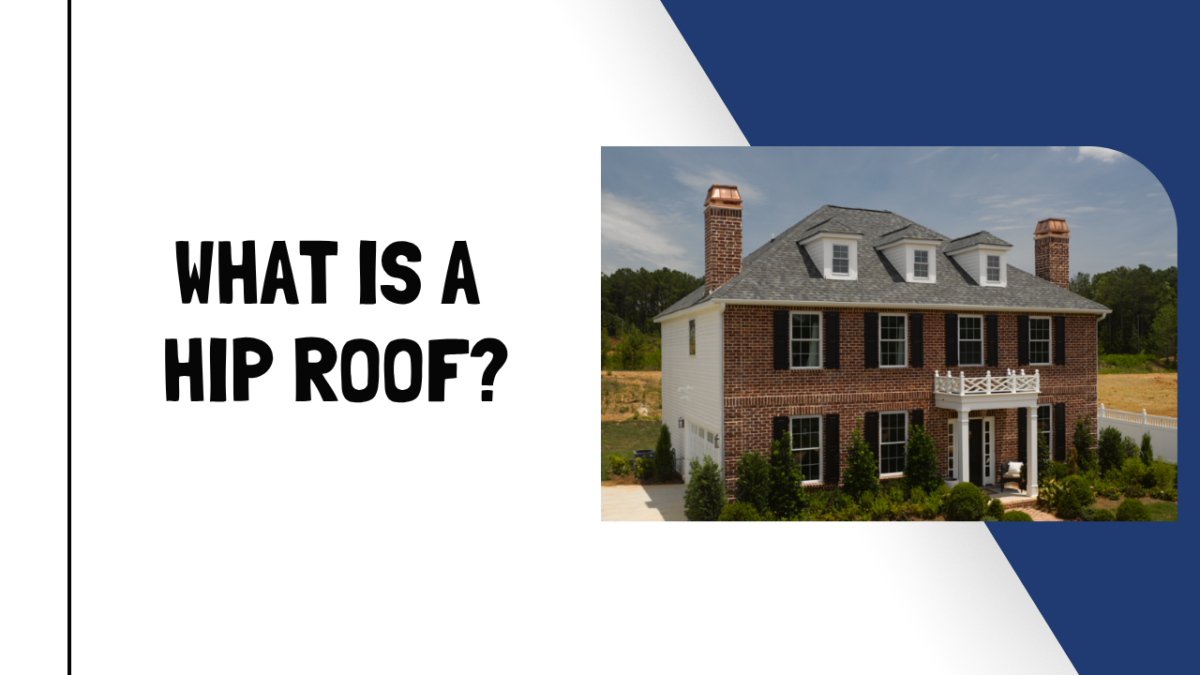
Hello guys, welcome back to my blog. So a lot of you guys keep asking me what is a hip roof and how it is different from a normal roof, so today I am going to answer that in full detail. I even went and read what real roofers and builders are saying about hip roofs on Reddit, so you get the honest picture, not just some sales pitch.
If you are planning a new build or looking at replacing your roof, you probably already heard the word “hip roof” from your contractor. Knowing what is a hip roof before you decide anything will help you understand what type it come in, and where it can give you trouble too. Let’s get into it.
So What Is A Hip Roof, Exactly
A hip roof is a roof where all four sides slope down toward the walls and meet at what is called “hips,” instead of having flat vertical wall sections like a gable roof. There is no vertical gable end at all. As one builder on r/architecture put it, hip roofs “have slopes on all sides that meet at the walls,” and that is really the simplest way to understand it.
Because there is no gable end, a square hip roof end up looking almost like a pyramid, while a rectangle house get two triangle shape sides and two trapezoid shape sides. The place where two slopes meet on the outside angle is called a hip, and roofers on r/Roofing will tell you straight up, “hips are so hard to put together.” I think that line alone tells you this is not the easiest roof shape to build.
Main Types Of Hip Roofs
This is a part I think most homeowner don’t even know about. Hip roof is not just one style, it actually come in a few different version depending on the shape of your house.
- Simple hip roof: the most common type, four slopes come together at a central ridge line.
- Pyramid hip roof: used on square shaped building, all four sides meet at one single point with no ridge at all.
- Cross hip roof: made for L-shaped or T-shaped homes, it has more then one ridge that intersect each other.
- Half hip roof: the gable end is partly “clipped” with a small hip section, popular in England, Germany, and a few other European countries.
- Dutch gable roof: a small gable is placed on top of a hip roof, this actually makes framing simpler because you don’t need special girder trusses.
According to Wikipedia, these designs go back a long way and are still very common all over the world today, from regular homes to bigger public buildings.
How A Hip Roof Is Actually Built
Roofers on r/Roofing mention that a hip roof can end at a full ridge, or sometimes at “a very short ridge” if the main attic section is small. So it’s not always one fixed design, it can be adjust based on the house shape.
As per This Old House, hip roofs “use special rafters called jack rafters, which need to get cut at a 45-degree angle to properly fit against the hip roof’s beam.” That’s honestly a lot more precision cutting compare to a simple gable roof.
There is also a debate among builders on whether to use rafters or pre-fab trusses. A comment on r/StructuralEngineering explains that “hip roofs can be built either with rafters and a ridge beam or with pre-fab trusses,” and another reply on the same thread adds that “trusses can be cheaper and easier to install too.” My honest opinion, trusses have become the more popular pick now mostly because it save time and labor cost on the job site.
Why Hip And Valley Cutting Is So Tricky
If you ever wonder why hip roof cost more in labor, this is why. One roofer on r/Carpentry called their hip roof project “a fun project to lay out and cut, a little challenging but really satisfying.” I think that line sums up the whole thing, it is doable but it does need real skill, not a beginner job.
Every hip and valley need precise angle cut, and if it’s off even a little, water can find its way in over time. This is one reason contractor charge more labor for a hip roof compare to a plain gable roof.
Hip Roof vs Gable Roof
I know a lot of you are also deciding between hip and gable, so let me break that comparison down clearly.
According to the Building America Solution Center, which is run under the U.S. Department of Energy, wind tunnel testing shows “peak wind-induced pressures can be as much as 50% lower in a hip roof versus a gable roof.” That is a huge difference if you ask me, and it is also why hip roofs are so common in hurricane-prone states.
The same source says a hip roof is “inherently braced against racking,” while a gable roof need extra diagonal bracing to get similar strength. On the other hand, gable roof win on attic space and ventilation, since it is easier to add vents and get more usable storage up top.
| Feature | Hip Roof | Gable Roof |
|---|---|---|
| Wind resistance | Much better, up to 50% less pressure | Weaker, more prone to uplift |
| Attic space | Less, due to sloped sides | More usable space |
| Ventilation | Harder to vent | Easier to vent |
| Cost | More expensive | More budget-friendly |
| Construction | More complex, more labor | Simple to build |
Why Hip Roofs Handle Wind So Well
This is probably the biggest selling point of a hip roof. Because every side slope down and there is no flat gable wall for wind to push against directly, the whole shape act more aerodynamic. A homeowner building in a storm zone shared on r/Roofing, “I’m building a house in a hurricane prone country… I had this hip roof done recently,” and that alone tells you builders in high wind areas trust this roof shape a lot.
As per IIBEC, research from wind tunnel testing generally shows that “hip roofs deflect wind better than gable roofs.” The same research also found that ridges and corners stay the most vulnerable spot no matter what pitch you pick, so good flashing and installation at those points really matter.
Insurance And Cost Side Of Hip Roofs
Here is something people don’t talk about enough. According to Progressive, a hip roof is “incredibly stable and perform well against extreme winds because they have no flat face for the wind to catch,” which is why many insurance company offer wind mitigation credit for this shape, sometime up to 90 percent when combine with other wind-resistant feature. So the higher upfront cost can pay you back a bit over time through lower insurance premium.
Speaking of upfront cost, a hip roof usually run between $7 to $14 per square foot, while a gable roof cost around $6 to $12 per square foot. For a full project, total hip roof replacement can land anywhere between $10,000 to $20,000 or more, mostly because of higher material waste (around 20 percent, compare to under 5 percent on a flat roof) and more cutting and labor time.
Quick Cost Comparison Table
| Roof Type | Cost Per Sq. Ft. | Total Replacement Cost |
|---|---|---|
| Flat | $5–$10 | $6,000–$12,000 |
| Gable | $6–$12 | $8,000–$16,000 |
| Hip | $7–$14 | $10,000–$20,000+ |
Source: RoofReplacementCost.ai
Pros And Cons Of A Hip Roof
Let me just put this in simple list form so it’s easy for you guys to scan.
Good things about hip roof:
- Handle wind and storm much better then gable
- Self-bracing structure, needs less extra bracing
- Water drain off easy from all four side
- Look nice and add curb appeal on many home style
Downside of hip roof:
- Cost more in material and labor
- Less attic space and storage
- Harder to add vents and gable windows
- More seams, which as per EcoWatch “can leave you vulnerable to roof leaks” if not installed or maintained right
Quick Facts Table
I always like to add a fast scan table so you guys don’t have to read the whole blog again.
| Fact | Detail |
|---|---|
| Basic definition | All four sides slope to the wall, no gable ends |
| Common types | Simple, pyramid, cross hip, half hip, dutch gable |
| Wind pressure vs gable | Up to 50% lower |
| Cost per sq ft | $7–$14 |
| Total replacement cost | $10,000–$20,000+ |
| Material waste | Around 20% |
| Insurance discount potential | Wind mitigation credit, up to 90% combined with other features |
| Roof lifespan (material dependent) | 10–75 years |
Frequently Asked Questions
Q: What is a hip roof in simple words? A: A hip roof is a roof shape where all sides slope down to the walls and meet at hips, with no vertical gable ends at all.
Q: Is a hip roof better then a gable roof? A: For wind resistance, yes, hip roofs perform a lot better. But gable roofs are cheaper and give more attic space, so it depends what you need most.
Q: Why is a hip roof more expensive? A: It need more cutting, more skilled labor for the hips and valleys, and it also generate more material waste compare to a simple gable roof.
Q: Does a hip roof help with insurance? A: In many case, yes. Some insurance company offer discount for hip roofs because of their better wind performance in storms.
Q: What are the main types of hip roof? A: The main types are simple hip, pyramid hip, cross hip, half hip, and dutch gable roof.
Final Words
So guys, this was my full breakdown on what is a hip roof, the different types, how it get built, and how it compare to a gable roof on cost and performance. My honest opinion, if you live in a windy or storm-prone area, a hip roof is really worth the extra cost. Keep on visiting Write for Us Roofing for more roofing guides like this.
Sources
- r/architecture – Hip roof discussion (Reddit)
- r/Roofing – Steel hip roof build (Reddit)
- Wikipedia – Hip Roof
- r/Roofing – Box vs ridge vents on hip roof (Reddit)
- This Old House – Roof Shapes Guide
- r/StructuralEngineering – Trusses vs rafters (Reddit)
- r/Carpentry – Bastard hip roof build (Reddit)
- Building America Solution Center – Hip Roof vs Gable Roof
- r/Roofing – Hip roof in hurricane zone (Reddit)
- IIBEC – Steep-Slope Roofs in the Wind
- Progressive – Florida Wind Mitigation Discounts
- RoofReplacementCost.ai – Roof Replacement Cost by Type
- EcoWatch – Hip Roof Cost Guide