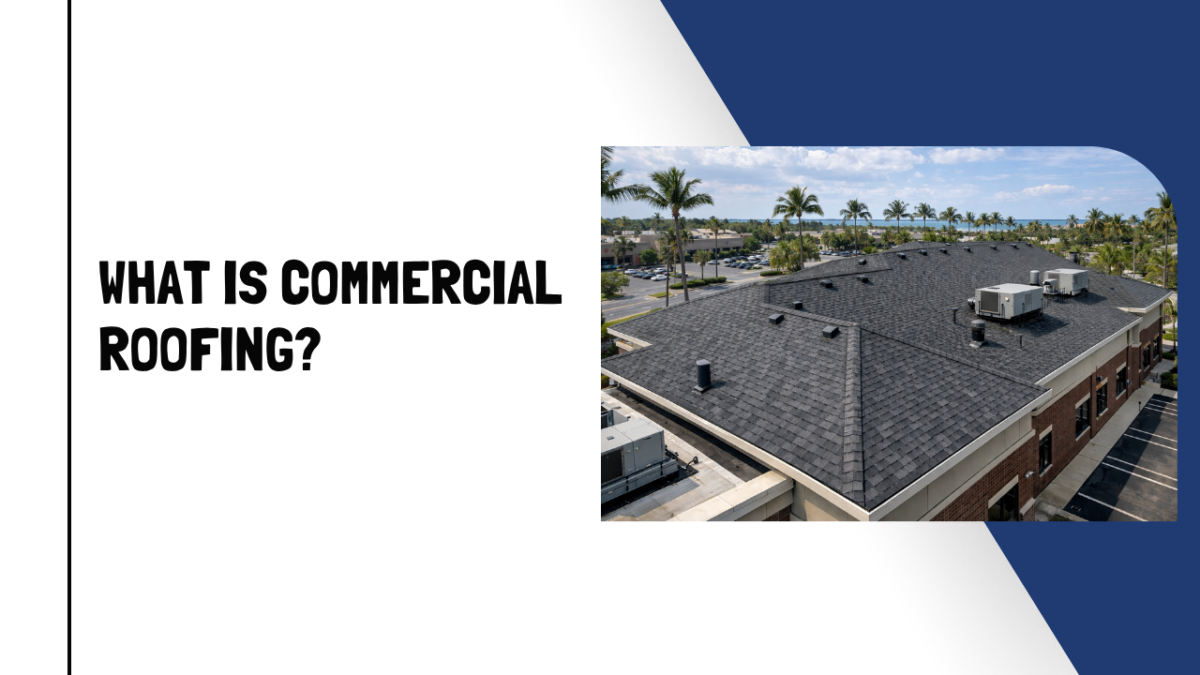
Hello guys, welcome back to my blog. A lot of you guys keep messaging me asking what is commercial roofing and how it is even different from the roof on a normal house. So today I am going to break that down for you in full detail, in simple words.
I even went and read what actual commercial roofers are saying about this on Reddit, so you get the real picture, not just some sales page talk. If you own a store, office, warehouse, or apartment building, or you are just curious what is commercial roofing all about, this blog is for you.
So What Is Commercial Roofing Exactly
In simple words, this is what is commercial roofing — it is the work of installing, repairing, and maintaining roofs on buildings that are not homes. Think stores, offices, warehouses, schools, and apartment buildings. It is a totally different game than putting shingles on a house.
Most commercial buildings have a low-slope or completely flat roof, not the steep pointy roof you see on houses. Because of this, the material and the whole way of installing it is different too. As per GAF, commercial roofing covers single-ply membranes like TPO and PVC, asphaltic membranes like modified bitumen, liquid-applied coatings, and even hybrid systems that mix technologies together.
My honest opinion, commercial roofing is a whole different trade compare to residential. It need different tools, different training, and honestly a different kind of business mindset too, which I will explain more below.
Types Of Commercial Roofing Materials
There is not just one type of commercial roof. Depending on the building, budget, and climate, contractors pick from a few main systems. As per GAF, here are the big ones:
| Material | What It Is | Best For |
|---|---|---|
| TPO | Single-ply, heat-welded membrane | Reflective, budget-friendly flat roofs |
| PVC | Single-ply membrane, warranty up to 30 yr | Ponding water, chemical exposure |
| EPDM | Rubber membrane, glued/taped seams | Budget projects, black roofs |
| Modified Bitumen (APP/SBS) | Asphalt-based sheets | Flexibility, impact resistance |
| Built-Up Roofing (BUR) | Layers of tar and gravel | Large, older, heavy-duty buildings |
| Metal | Panels, sometimes standing seam | Long lifespan, mixed slope buildings |
Roofers on r/Roofing also confirm this, saying low-slope membranes like TPO, PVC, and EPDM are “common” on commercial buildings, and metal and built-up roofs get used a lot on bigger buildings too. Another roofer on the same thread mention that their crew install “millions of sq ft of TPO every single month,” and most of it is mechanically attached, not glued. I think this shows TPO is basically the default pick for a lot of commercial jobs today.
How Commercial Roofing Is Different From Residential Roofing
This is honestly the part most people don’t know, so let me break it down properly.
As per the Roofr blog, a commercial roof is “typically very low or fully flat,” while a home roof has a steeper pitch to shed rain and snow better. Commercial roofs also have several layers, like insulation, decking, a protective layer, and a reflective coating, while a home roof is usually just plywood, underlayment, and shingles.
Commercial roofs also need to hold a lot more weight then a house roof. They often carry heavy stuff like HVAC units and industrial pipeline, something a normal house roof almost never has to deal with beyond maybe a skylight or solar panel.
The installation side is different too. According to GAF, a residential crew of 4 to 6 workers can finish a normal home roof in a single day using basic tools like nail guns. Commercial jobs, on the other hand, can take anywhere from several days to months, and the crew need specialized gear like hot air welding equipment and induction welders that can cost tens of thousands of dollar.
Quick Comparison Table
| Factor | Commercial Roofing | Residential Roofing |
|---|---|---|
| Roof slope | Low-slope or flat | Steep pitch |
| Common materials | TPO, PVC, EPDM, BUR, modified bitumen | Shingles, tile, shakes |
| Crew size / time | Larger crew, days to months | 4–6 workers, usually 1 day |
| Extra weight support | HVAC units, pipelines | Rarely more then a skylight |
| Installation method | Heat welding, adhesive | Nail guns |
| Payment terms | Often 30, 60, or 90-day cycles | Usually paid on completion |
If you ask me, this table alone explains why a commercial roofer and a residential roofer are basically two different jobs, even though both say “roofer” on their business card.
How Commercial Roofs Are Actually Installed
A big thing people get confuse about is how these membranes actually stay on the roof. Roofers on r/Roofing explain that a mechanically attached system is “not an adhered roof system,” so it will expand and contract more with the temperature outside compare to a glued down or heat-welded one.
Commercial crews also need proper training and certification from the manufacturer before they can even offer a warranty, according to GAF. This is not really a thing on most residential jobs, so it tells you how serious the manufacturer take commercial installs.
What Real Roofers Say About Commercial Work
I did not want to just repeat marketing stuff, so I went through actual roofer discussions to see what the honest challenges are.
Sales is different. Commercial jobs are not really something you sell door to door. One comment on r/RoofingSales explains that commercial work “usually comes through relationships, vendor lists, referrals, property managers, facility managers, general contractors, and tender opportunities.” This means it take a lot longer to land your first job compare to residential.
Jobs are more complicated. Another roofer on r/RoofingSales point out plainly that commercial roofs are “a lot more complicated then residential,” and you need actual skilled crew to handle it, not just anyone with a ladder.
Labor shortage is real. A commercial roofer on r/Roofing said there is a “shortage of skilled trades,” and they are literally turning down huge commercial jobs because they can’t find good roofers to do the work.
Quality control is a headache too. In a longer post on r/Roofing, a commercial roofer vent that their jobs are “constantly understocked,” and some companies are now hiring supervisors “strictly based on if they have college degrees” instead of actual roofing experience. My honest opinion, that sound like a recipe for problems on the roof.
Vendor lists are tough to crack. One roofer on r/RoofingSales mention that some property managers already have “30 other approved roofing vendors,” so a new contractor should “be prepared to bend over for $200 service calls” just to get a foot in the door.
How Contractors Get Commercial Roofing Work
If you are wondering how a commercial roofer actually finds clients, it is mostly about relationship and reputation, not ads.
As per one roofer on r/RoofingSales, a simple move is to “talk to local business owners” and actually get to know them, instead of just cold pitching.
Another suggestion from r/RoofingSales is joining local industry groups like BOMA and IREM chapters, and using a simple, timed message like “I noticed your building’s roof is coming up on X years, want a free assessment,” instead of a generic sales pitch.
Contractors also need to be ready with the boring but important stuff, like proper insurance and safety documentation, because most commercial clients won’t even consider a bid without it.
Cost Of Commercial Roofing
Now let’s talk numbers, because I know this is what most of you guys actually want to know.
According to Angi, flat and low-slope roof replacement usually cost between $3,331 and $11,558 total, with labor alone running $3 to $7 per square foot. Here is how the material cost breaks down per square foot installed.
| Material | Cost Per Sq. Ft. (Installed) |
|---|---|
| TPO | $4–$14 |
| EPDM | $5–$13 |
| Rubber (general) | $4–$13 |
| Modified Bitumen | $4–$8 |
| Built-Up Tar | $4–$10 |
| Fiberglass | $4–$6 |
I think it is smart to always get more then one quote before picking a contractor, because the price range on these material is honestly pretty wide.
Quick Facts Table
I always like adding a quick fact table so you guys can scan this fast without reading the whole blog again.
| Fact | Detail |
|---|---|
| What it covers | Roofs on non-residential buildings (stores, offices, warehouses, apartments) |
| Common roof shape | Low-slope or fully flat |
| Common materials | TPO, PVC, EPDM, modified bitumen, BUR, metal |
| Typical crew size | Larger crew, jobs can take days to months |
| US roofing contractor market size (2026) | $100.5 billion, per IBISWorld |
| Oldest major trade association | NRCA, founded in 1886 |
| How work is found | Referrals, property managers, vendor lists, GCs |
That NRCA fact honestly surprised me a bit. An association running since 1886 tells you commercial and trade roofing has been a serious, organized industry for a very long time, not some new thing.
Frequently Asked Questions
Q: What is commercial roofing in simple words? A: Commercial roofing is the work of installing, repairing, and maintaining roofs on non-residential buildings like offices, stores, warehouses, and apartment complexes, usually using low-slope membrane systems instead of shingles.
Q: What is the most common commercial roofing material? A: TPO is one of the most common choices right now because it is budget-friendly and reflective, though EPDM, PVC, modified bitumen, and built-up roofing are also widely used.
Q: How much does commercial roofing cost? A: According to Angi, flat and low-slope commercial roofs typically cost $3,331 to $11,558 total, with material cost ranging from about $4 to $14 per square foot depending on the system.
Q: Is commercial roofing harder then residential roofing? A: In many ways yes. Commercial roofs are bigger, need specialized welding equipment, require manufacturer certification, and the sales process is longer and more relationship-based.
Q: How do commercial roofers usually get new clients? A: Mostly through relationships, referrals, property and facility managers, general contractors, and local industry groups like BOMA or IREM, not through typical residential-style advertising.
Final Words
So guys, this was my full breakdown on what is commercial roofing, the materials used, how it is different from residential roofing, what real roofers say about the challenges, and roughly what it cost. My honest opinion, commercial roofing is a serious trade on its own, with its own tools, rules, and way of finding work. Keep on visiting Write for Us Roofing for more roofing guides like this.
Sources
- GAF – Commercial Roofing Materials
- GAF – Commercial vs Residential Roofing: What Are The Differences
- Roofr – 5 Key Differences of Residential and Commercial Roofing
- Angi – How Much Does Flat Roof Replacement Cost?
- NRCA – About the National Roofing Contractors Association
- IBISWorld – Roofing Contractors Market Size in the US
- r/Roofing – Low-slope membranes and TPO installs (Reddit)
- r/Roofing – Mechanically attached TPO comment (Reddit)
- r/RoofingSales – How commercial work comes through relationships (Reddit)
- r/RoofingSales – Commercial roofs are more complicated comment (Reddit)
- r/Roofing – Skilled trade shortage comment (Reddit)
- r/Roofing – A rant from a commercial roofer (Reddit)
- r/RoofingSales – Vendor list and $200 service calls comment (Reddit)
- r/RoofingSales – Talk to local business owners comment (Reddit)
- r/RoofingSales – BOMA and IREM networking comment (Reddit)