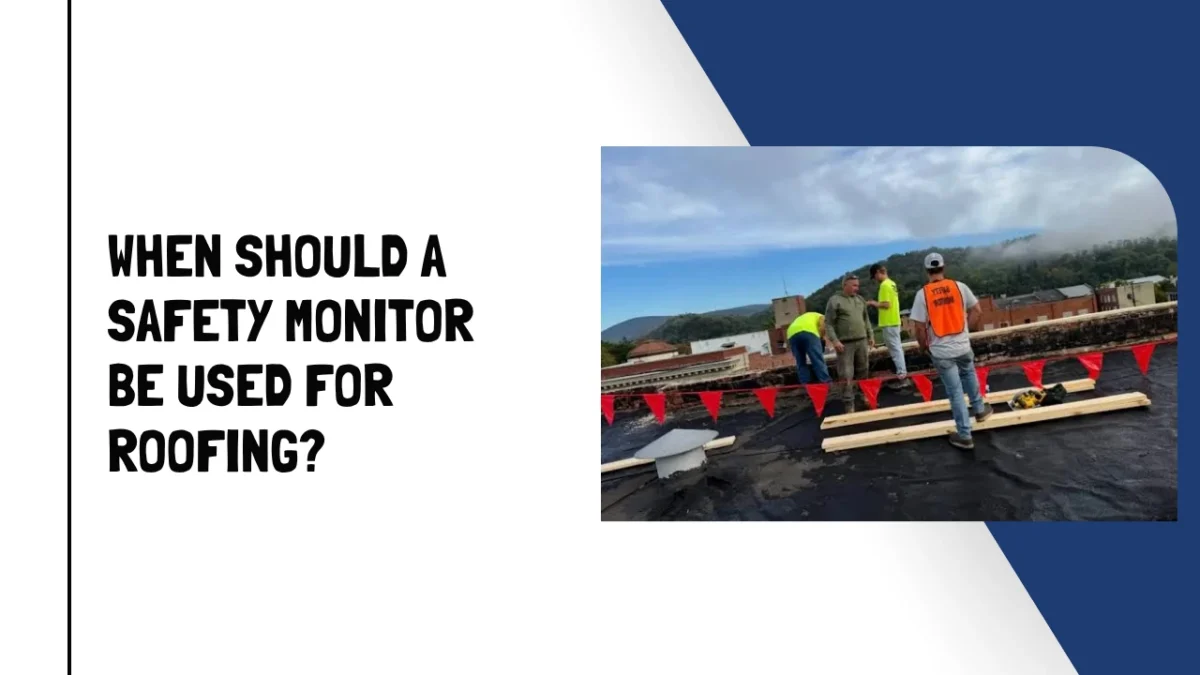
Hello guys, welcome back to my blog. Today I am going to tell you about when should a safety monitor be used for roofing, because I saw a lot of confusion about this on a safety forum on reddit.com. This is a small but very important topic if you work on roofs or hire people who do.
What Is a Safety Monitor, In Simple Words
A safety monitor is just one person whose only job is to watch other workers on the roof. He does not do any roofing work himself. He just stands there and warns workers when they get too close to the edge or when they are doing something unsafe.
I think this is a smart idea on paper, but it also depends a lot on how alert that one person is. If he looks away for two seconds, that can be a big problem.
When You Can Use a Safety Monitor Alone
Here is the main answer, so you don’t have to read the whole blog if you are in a hurry.
| Question | Answer |
|---|---|
| When should a safety monitor be used for roofing? | On low-slope roofs that are 50 feet or less in width, as the only fall protection, if no mechanical equipment (other than a wheelbarrow) is being used |
| Rule that covers this | 29 CFR 1926.501(b)(10) |
| Duties of the monitor | Covered under 29 CFR 1926.502(h) |
| Do you need to prove other methods are not possible? | No, not for roofs under 50 feet wide |
This information comes from a discussion on the r/SafetyProfessionals subreddit, where safety people talked about this exact question. I also checked it against the actual OSHA rule, and it matches.
According to OSHA’s own regulation 1926.501, for low-slope roofs with unprotected edges 6 feet or more above the ground, employers must use guardrails, safety nets, personal fall arrest systems, or a warning line system combined with one of those. But there is one exception, and this is the main point of this blog: on roofs that are 50 feet wide or less, the employer can use a safety monitoring system all by itself, with no warning line needed.
OSHA Rules for the Monitor Himself
A lot of people on that reddit thread also asked, what does the monitor actually have to do? I looked this up in OSHA 1926.502(h), and here is what I found, in simple language.
| Rule | What It Means |
|---|---|
| Must be competent | He should know how to spot a fall hazard |
| Must stay on same surface | He has to be on the same roof, not below or on a ladder |
| Must be within sight | He needs a clear visual line to the worker |
| Must be close enough to talk | He should be able to warn the worker by voice |
| No other job | He cannot be doing roofing work at the same time |
| Only roofers allowed in the zone | Only people doing the roofing work can be in that monitored area |
I really like this rule about “no other job” because it makes sense. If the same guy is also carrying shingles, how can he watch the edge properly at the same time? On the reddit thread, one commenter explained this same point, saying the monitor is basically a lookout for ledge proximity, nothing more, nothing less.
The Mechanical Equipment Rule
This one is very important, so I am putting it in its own section. If you are using mechanical equipment on the roof, other than a wheelbarrow, a safety monitor alone is not enough anymore.
One user on the reddit thread pointed this out clearly: anytime mechanical equipment is being used while using a safety monitor, workers must also be tied off with a personal fall arrest system. So a safety monitor is not a free pass to skip tie-off once machines come into the picture.
This part of the rule is also explained clearly on Up.Codes’ summary of the safety monitoring standard, which says mechanical equipment shall not be used or stored in areas where a safety monitoring system alone is being used for roofing operations.
Is a Safety Monitor the Best Choice? My Honest Opinion
If you ask me, no. A safety monitor should be your last option, not your first one.
Guardrails, safety nets, and personal fall arrest systems physically stop a fall or catch you. A safety monitor is just a person shouting a warning. If that person is late, or distracted for one second, there is nothing else stopping the fall.
An OSHA standard interpretation letter from 2012 also confirms that there is no minimum offset distance required between the worker and the roof edge when using a safety monitor. This means the worker could technically be right at the edge, and the only thing protecting him is the monitor’s voice. I find that a bit risky, honestly.
Also, if something does go wrong while you were only using a safety monitor, you as the employer better be ready to explain why you did not use a stronger method. This is a real risk I would not want to take on a job site.
Why This Actually Matters
I am not just saying this to sound dramatic. Roofing is genuinely one of the most dangerous jobs in the country. According to a roofing safety fatality report, roofing was the third-deadliest civilian job in 2024, and about 84 percent of roofer deaths came from falls, slips, or trips. Fall protection has also been OSHA’s most-cited violation for 15 years in a row.
| Fact | Number |
|---|---|
| Roofer deaths in 2024 | 104 |
| Roofer deaths caused by falls | About 84 percent |
| Roofing’s rank among dangerous jobs | 3rd deadliest, after logging and fishing |
| Years fall protection has been OSHA’s top citation | 15 years in a row |
So this is not a small rule to skip. A safety monitor for roofing can be legal and useful in the right situation, but you have to know exactly when it applies.
FAQ on Safety Monitors for Roofing
Q: When should a safety monitor be used for roofing? A: Only on low-slope roofs that are 50 feet wide or less, when no mechanical equipment other than a wheelbarrow is being used, and no other fall protection is in place.
Q: Can one person be a safety monitor and also do roofing work? A: No. The monitor cannot have any other job that could take his attention away from watching workers.
Q: Do I need to show that guardrails or safety nets are not possible before using a safety monitor? A: No, not on roofs that are 50 feet or less in width. You are allowed to just choose a safety monitor directly.
Q: Is a safety monitor as safe as a guardrail or harness? A: In my opinion, no. It is the weakest form of fall protection because it depends on one person’s attention, not a physical barrier.
Final Words
So this was my simple explanation on when should a safety monitor be used for roofing. I covered the 50 feet rule, what the monitor must do, the mechanical equipment restriction, and why I personally think it should be your last choice, not your first. I hope this clears up the confusion, just like it helped me understand it better while researching. Keep on visiting my blog for more roofing safety tips.
Sources
- r/SafetyProfessionals – Safety Monitor for Roofing under 50ft
- r/SafetyProfessionals – comment on monitor’s purpose
- r/SafetyProfessionals – comment on mechanical equipment rule
- OSHA 1926.501 – Duty to have fall protection
- OSHA 1926.502 – Fall protection systems criteria and practices
- Up.Codes – Safety Monitoring Systems summary
- OSHA Standard Interpretation, 2012-04-20
- The Roofing Brief – Roofing Safety & Fatality Report